How Much to Tip in Every Situation (2026 Guide)

Tipping in America has become genuinely confusing. You grab a drip coffee and the tablet spins around with suggested tips of 18%, 20%, and 25%. You pick up a pizza you ordered online and there is a tip line on the receipt. You buy a bottle of water at a counter and the screen asks if you would like to leave a gratuity. At some point, you have probably stood there frozen, doing panicked mental math while a line forms behind you, wondering what the "right" amount even is anymore.
Meanwhile, the tipping standards that used to feel simple have shifted. Fifteen percent at a restaurant — once the default — is now considered on the low end. Twenty percent is the new baseline. Delivery drivers, rideshare drivers, hotel housekeepers, barbers, tattoo artists, movers, dog groomers — they all have different expectations, and very few of them are written down anywhere obvious.
This guide lays it all out. Every common tipping situation, what to tip, when you can skip it, and how to do the math in your head in about three seconds. No more awkward freezes at the payment terminal.
Need a quick answer right now? Calculate the tip and split the bill instantly.
Try the Free Tip Calculator →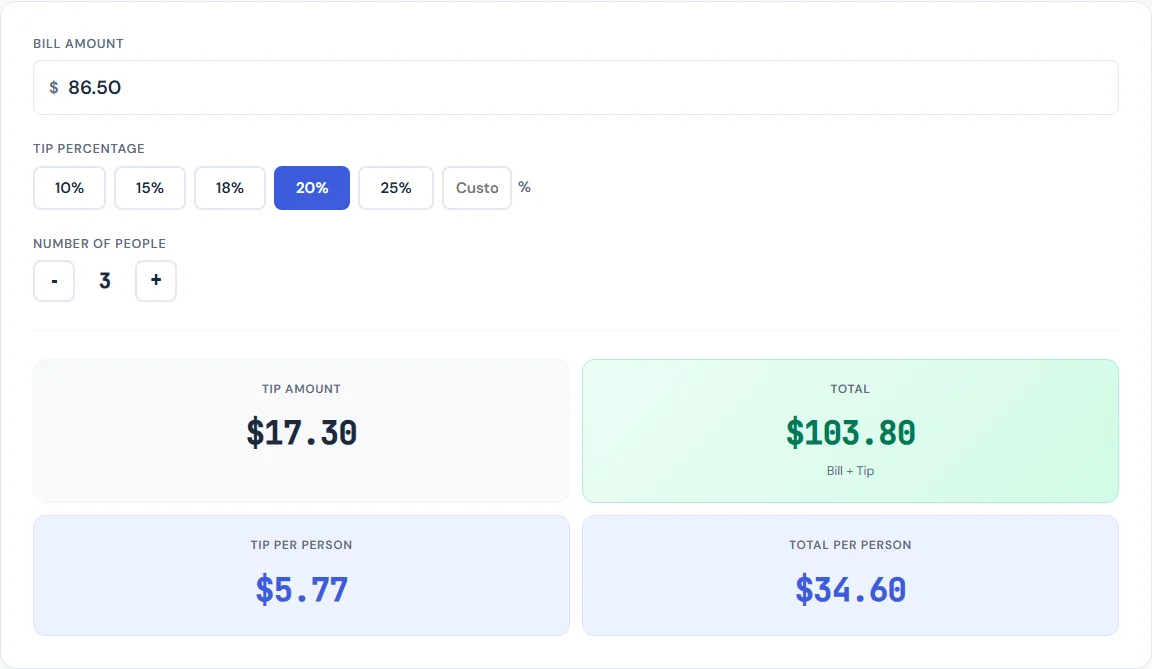
The Standard Tipping Rules in 2026
Before we get into the full breakdown, here are the big-picture rules that cover most everyday situations:
Sit-down restaurants: 18–20% of the pre-tax bill is now the standard tip for good service. This is not a generous tip — it is the expected baseline. Servers in the United States are paid a federal tipped minimum wage of just $2.13 per hour (some states are higher, but many are not). Tips are not a bonus. They are the majority of a server's income. If your service was fine and nothing went wrong, 18–20% is what is expected. Going below 15% sends a strong negative signal.
Coffee shops and counter service: This is where things get murkier. A dollar or two is perfectly fine for a drip coffee or a simple order. For elaborate handcrafted drinks — a custom latte, a blended drink with six modifications — 10–15% is a kind gesture. But here is the thing that matters: counter-service tips are genuinely optional. The tablet tip screen is designed to make you feel obligated, but nobody is judging you for hitting "No Tip" on a $3 coffee. The barista making your pour-over by hand? That is different. Use your judgment.
Food delivery: 15–20%, with a minimum of $3–5 even on small orders. Delivery drivers use their own car, pay for their own gas, and deal with wear and tear on their vehicle. A $2 tip on a $12 order that took 30 minutes to deliver is not adequate. If the weather is bad, tip more. If the driver had to climb four flights of stairs, tip more.
Rideshare (Uber/Lyft): 15–20% or a $2–5 minimum on short rides. This is one area where tipping norms have solidified quickly. A few years ago, Uber explicitly told riders not to tip. That era is over. Drivers rely on tips, and the app makes it easy. If someone safely navigated you through traffic, a tip is expected.
How Much to Tip in Every Situation
Here is the comprehensive reference table. Bookmark this page — you will come back to it.
| Service | Standard Tip | Great Service | Notes |
|---|---|---|---|
| Sit-down restaurant | 18–20% | 22–25% | On pre-tax subtotal |
| Buffet | 10–15% | 15–18% | Lower because you serve yourself |
| Takeout | 0–10% | 10–15% | Becoming more common post-2020 |
| Coffee shop / counter | $1–2 or 10% | 15% | Optional for simple orders |
| Food delivery | 15–20% | 20–25% | $3–5 minimum even on small orders |
| Grocery delivery | 10–15% | 20% | Higher in bad weather |
| Rideshare | 15–20% | 20%+ | $2 minimum on short rides |
| Taxi | 15–20% | 20–25% | Round up if fare is under $10 |
| Hotel housekeeping | $2–5/night | $5–10/night | Leave daily, not just at checkout |
| Valet parking | $2–5 | $5–10 | When car is returned |
| Hairdresser / barber | 15–20% | 20–25% | On full service price |
| Spa / massage | 15–20% | 20–25% | Check if gratuity is included |
| Tattoo artist | 15–20% | 20–30% | Standard in the industry |
| Movers | $20–50/person | $50+/person | For a full-day move |
| Furniture delivery | $5–20/person | $20–40/person | More for assembly |
| Dog groomer | 15–20% | 20–25% | On total grooming cost |
A few things worth noting about this table. Hotel housekeeping is the most commonly forgotten tip, and it is also one of the most important. Housekeepers are among the lowest-paid workers in the hospitality industry, and their work is physically demanding. The reason you should leave the tip daily (rather than a lump sum at checkout) is that different housekeepers may clean your room on different days. A $5 bill on the nightstand with a note that says "thank you" goes further than you think.
Movers are another category people often underestimate. If three people spent eight hours carrying your entire life up three flights of stairs in July heat, $20 each is the floor, not the ceiling. These are physically brutal jobs, and a good tip is remembered.
How to Calculate a Tip in Your Head
You do not need an app for this (though we built a good one). Here are four mental math tricks that work every time:
The 10% anchor. Every tip calculation starts here. To find 10% of any number, just move the decimal point one place to the left. A bill of $86.50 becomes $8.65. A bill of $142.00 becomes $14.20. You now have your anchor.
For 20%: double the 10%. This is the easiest standard tip to calculate. $86.50 → 10% is $8.65 → double it → $17.30. Done. Twenty percent in two seconds.
For 15%: add half of 10% to the 10%. Take your 10% ($8.65), cut it in half ($4.33), and add them together: $8.65 + $4.33 = $12.98. Round to $13. It sounds like more steps, but with practice it becomes automatic.
For 18%: take 20% and subtract a bit. Calculate 20% ($17.30) and shave off roughly 10% of that amount ($1.73): $17.30 − $1.73 = $15.57. Round to $15.50 or $16. Close enough. Nobody is auditing your tip to the penny.
And the simplest trick of all: round up generously. If the bill is $47.30 and you want to tip 20%, that is $9.46. Just leave $10. The extra 54 cents means nothing to you and makes the math instant. When in doubt, round up. Your server will appreciate the extra quarter more than you will miss it.
If the math still feels like a chore — or if you are splitting a bill four ways after three rounds of drinks — the Tip Calculator handles everything in one tap. Enter the bill, pick a percentage, set the number of people, and it tells you exactly what each person owes.
Should You Tip on the Pre-Tax or Post-Tax Total?
This is one of the most debated questions in tipping etiquette, and the answer is straightforward: proper etiquette says to tip on the pre-tax subtotal.
The reasoning is simple. Sales tax is money that goes to the government. Your server did not earn a percentage of the tax — they earned a percentage of the food and service they provided. Tipping on the tax inflates the base by an amount that has nothing to do with the service you received.
Here is what the difference actually looks like. Say your meal costs $86.50 before tax. With an 8.5% tax rate, the tax adds $7.35, bringing the total to $93.85.
- 20% on pre-tax ($86.50): $17.30
- 20% on post-tax ($93.85): $18.77
The difference is $1.47. On a single meal, that is negligible. But if you eat out twice a week, that adds up to about $150 over the course of a year. Not life-changing, but not nothing either.
In practice, many people tip on the total because it is easier — the total is the big number at the bottom of the receipt and requires no additional scanning. That is completely fine. No server will object to receiving a slightly larger tip. Just know the distinction so you can make a conscious choice rather than a default one.
When You Do Not Need to Tip
Tipping culture has expanded aggressively, but that does not mean every transaction requires a tip. Here are the situations where tipping is genuinely not expected:
Business owners who set their own prices. If the person providing the service also owns the business and sets the prices, tipping is traditionally not expected. The logic is that they have already built their compensation into their pricing. That said, this norm is softening — many people tip their salon owner or independent contractor anyway, and it is always appreciated.
Self-checkout and zero-service interactions. If you scanned your own items, bagged your own groceries, and completed the transaction without any human assistance, there is no one to tip. The tip prompt on a self-checkout screen is a software default, not a social expectation.
Fast food drive-throughs. Tip jars exist at some locations, but tipping at a drive-through window is not an established norm. These workers are paid hourly wages (not tipped minimum wage), and the service model is fundamentally different from sit-down dining.
Countries where tipping is not the custom. In Japan, tipping can actually be considered rude — it implies the worker needs charity. In South Korea, Australia, and most of Western Europe, service charges are included in prices or workers are paid a living wage. If you are traveling internationally, research the local norms before you tip. What feels polite in New York can feel awkward in Tokyo.
When a service charge or gratuity is already included. This is critical: always check the receipt. Many restaurants automatically add an 18–20% gratuity for large parties (typically six or more guests). Some restaurants have moved to a mandatory service charge model. If the tip is already on the bill, you do not need to add another one on top. Double-tipping because you did not read the receipt is the most expensive mistake in this entire guide.
One important caveat: "no obligation" is not the same as "never." If someone provides exceptional service in any of these situations, a tip is always welcome. The barista who remembers your name, the fast food worker who fixed a mistake cheerfully, the hotel concierge who went out of their way — generosity is never wrong.
Splitting the Bill with a Group
Group dinners are where tipping gets genuinely complicated. Five friends, three appetizers, two bottles of wine that only two people drank, someone who ordered a salad, and someone who ordered the lobster. The check arrives and everyone reaches for their phone. Here are the three most common approaches:
Equal split. Divide the total (including tip) by the number of people. This is the fastest and simplest method. It works best when everyone ordered roughly the same price range. If the bill is $240 with a $48 tip (20%), the total is $288 divided by 4 people = $72 each. Clean, easy, done in ten seconds.
Per-item split. Each person pays for exactly what they ordered, plus their proportional share of the tip. This is the fairest method when orders vary wildly — the person who had a $16 salad should not subsidize the person who had a $55 steak. The downside is that it requires itemizing the bill, which takes time and can feel awkward. Someone inevitably forgets to account for shared appetizers or that second round of drinks.
The compromise. Split equally, but the person who ordered the most expensive item (or the most drinks) covers a larger share or picks up the tip. This is the social sweet spot — it feels fair without requiring a forensic analysis of the receipt. Something like: "I had the lobster, so I will cover the tip" settles it elegantly.
Regardless of which method you choose, the most important rule is this: do not let the tip get lost in the shuffle. In group situations, everyone assumes someone else is covering it. Designate one person to handle the tip calculation, or better yet, use the Tip Calculator — enter the total, set the tip percentage, enter the number of people, and it gives you the per-person amount instantly. No debates, no underpaying, no over-complicating a dinner that was supposed to be fun.
Frequently Asked Questions
Is 15% still an acceptable restaurant tip?
It is the minimum for adequate service. 18–20% is the new standard in 2026. If service was truly poor, 15% still acknowledges that servers earn most of their income from tips. Below 15% sends a strong message and should be reserved for genuinely bad experiences.
Should I tip on the pre-tax or post-tax amount?
Technically, you should tip on the pre-tax subtotal. Tax goes to the government, not your server, so there is no reason to tip on it. But tipping on the full amount is common and perfectly fine. The difference is usually small, and servers will never complain about a slightly larger tip.
Do I need to tip for takeout orders?
It is not mandatory, but 10% is a nice gesture, especially for large or complex orders. During peak hours, kitchen staff and counter workers put real effort into packaging your food correctly. If you are ordering $80 worth of takeout, a few dollars goes a long way.
How much should I tip my hairdresser?
15–20% of the full service cost is standard. If the salon owner is doing your hair, tipping is optional but appreciated. For assistants who shampoo or style, $5–10 is standard. During the holidays, many people tip their regular stylist the cost of one session as a bonus.
Is it rude to use a tip calculator at the table?
Not at all. It is far more common now than ever, and it is better to calculate accurately than to guess wrong. Most people pull out their phone to figure out the tip, especially when splitting a bill. Nobody is judging you for doing math correctly.
BLIPP built SmarterSources to replace expensive subscriptions with free, private tools. Every tool runs in your browser — no sign-ups, no limits.