How to Calculate Calories and Macros for Weight Loss

Weight loss comes down to one fundamental equation: consume fewer calories than your body burns. This principle, known as energy balance, is supported by decades of metabolic research. No supplement, meal timing trick, or food combination can override it. If you eat fewer calories than you expend, your body draws from stored energy (primarily fat) to make up the difference. Over time, that deficit becomes measurable weight loss.
The problem is not the concept. The problem is that most people have no idea how many calories they actually need. They guess, follow generic advice like "eat 1,200 calories," or rely on fitness tracker estimates that can be off by 20% or more. Without knowing your personal baseline, you are either eating too little (which tanks your metabolism and muscle mass) or not enough of a deficit to see results.
This guide walks through the actual math behind calorie and macro calculations. No vague advice. Real formulas, real numbers, and a free calculator that does the work for you.
Want to see your personalized calorie and macro targets?
Calculate Your Calories Free →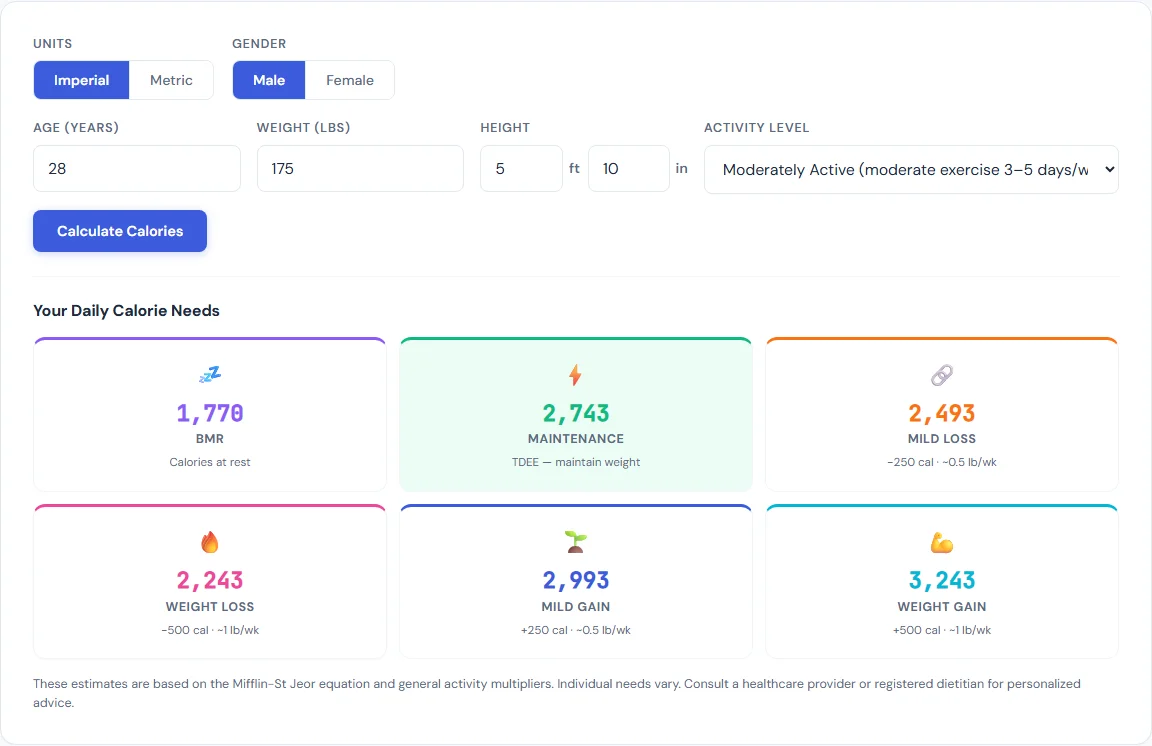
What Is TDEE?
TDEE stands for Total Daily Energy Expenditure. It represents the total number of calories your body burns in a 24-hour period, accounting for everything from breathing and digestion to walking and exercise. TDEE is the number you need to know before you can set a meaningful calorie target for weight loss, maintenance, or muscle gain.
TDEE is built from several components. The largest is your Basal Metabolic Rate (BMR), which accounts for roughly 60% to 70% of daily calorie burn. BMR is the energy your body requires just to stay alive at complete rest: pumping blood, regulating temperature, maintaining organ function, repairing cells. On top of BMR, your body burns calories through the thermic effect of food (about 10% of intake, used to digest and absorb what you eat), non-exercise activity thermogenesis (NEAT, which covers fidgeting, walking around the house, and other unconscious movement), and deliberate exercise.
When people say "I need to eat 2,000 calories a day," they are referencing their estimated TDEE. If you eat exactly your TDEE, your weight stays roughly the same. Eat below it, and you lose weight. Eat above it, and you gain. Every calorie-based diet plan, whether it uses those terms or not, is built on this relationship.
The Mifflin-St Jeor Formula
Several equations exist to estimate BMR. The Mifflin-St Jeor equation, published in 1990 by researchers at the University of Nevada, is considered the most accurate for the general population. The American Dietetic Association recommends it over the older Harris-Benedict equation (1919), which tends to overestimate calorie needs by 5% to 15%, especially in overweight individuals.
The Mifflin-St Jeor formulas are:
Men: BMR = (10 × weight in kg) + (6.25 × height in cm) - (5 × age in years) + 5
Women: BMR = (10 × weight in kg) + (6.25 × height in cm) - (5 × age in years) - 161
Let us work through an example. A 30-year-old man who weighs 185 pounds (84 kg) and stands 5'10" (178 cm):
BMR = (10 × 84) + (6.25 × 178) - (5 × 30) + 5 = 840 + 1,112.5 - 150 + 5 = 1,807.5 calories/day
That is his BMR, the minimum energy his body needs at complete rest. His actual daily burn (TDEE) will be significantly higher once activity is factored in. A moderately active version of this person would have a TDEE around 2,802 calories per day. That number is the starting point for setting a deficit.
The Harris-Benedict equation, by comparison, would estimate this person's BMR at approximately 1,905 calories, nearly 100 calories higher. Over the course of a month, that overestimation could mean the difference between losing weight and staying flat.
Activity Multipliers Explained
Once you have your BMR, you multiply it by an activity factor to get your TDEE. These multipliers come from research on energy expenditure and are standardized across most nutrition science references:
- Sedentary (1.2): Desk job, little to no exercise. If you drive to work, sit at a computer for 8 hours, drive home, and watch TV in the evening, this is you.
- Lightly active (1.375): Light exercise 1 to 3 days per week. Walking regularly, occasional gym sessions, or an active hobby once or twice a week.
- Moderately active (1.55): Moderate exercise 3 to 5 days per week. Consistent gym habit, regular running, recreational sports several times a week.
- Very active (1.725): Hard exercise 6 to 7 days per week. Training for a sport, physically demanding job combined with regular workouts, or high-volume training programs.
- Extra active (1.9): Very hard exercise plus a physical job. Construction workers who also train, competitive athletes in heavy training blocks, or military personnel in active duty.
The most common mistake is overestimating your activity level. If you exercise three times per week but spend the other 23 hours of each day sitting, you are closer to "lightly active" than "moderately active." Be honest with yourself here. Overestimating your activity factor by one tier inflates your TDEE by 200 to 300 calories per day, which can completely erase a moderate deficit.
Using our example above: the 30-year-old man with a BMR of 1,808 calories who exercises 3 to 5 days per week would multiply by 1.55, giving a TDEE of approximately 2,802 calories. If he honestly only trains twice a week and sits at a desk otherwise, the 1.375 multiplier gives a TDEE of 2,486 calories. That 316-calorie difference matters.
Calorie Deficit: The Math Behind Weight Loss
One pound of body fat stores approximately 3,500 calories of energy. This figure comes from metabolic research and, while it is a simplification (fat tissue also contains water and protein), it remains the standard reference used in clinical nutrition. To lose one pound per week, you need a daily deficit of about 500 calories (500 × 7 = 3,500).
Using our example: if the moderately active man has a TDEE of 2,802 calories and wants to lose one pound per week, he would target approximately 2,302 calories per day. For a more aggressive two-pound-per-week rate, the target drops to about 1,802 calories, which coincidentally sits right at his BMR. Going below BMR is generally not recommended because it can impair hormone function, reduce muscle mass, and trigger adaptive thermogenesis (your body slowing its metabolism in response to severe restriction).
Safe rates of weight loss for most people fall between 0.5 and 2 pounds per week. The commonly cited guidelines:
- 250-calorie daily deficit: approximately 0.5 lb per week. Sustainable, minimal muscle loss, barely noticeable in daily life.
- 500-calorie daily deficit: approximately 1 lb per week. The most commonly recommended target. Achievable through diet alone or a combination of diet and exercise.
- 750-calorie daily deficit: approximately 1.5 lb per week. More aggressive, may require careful attention to protein intake to preserve muscle.
- 1,000-calorie daily deficit: approximately 2 lb per week. The upper limit generally considered safe for most adults. Often only appropriate for individuals with significant weight to lose.
The SmarterSources Calorie Calculator shows six calorie targets automatically: Extreme Loss (-1,000), Weight Loss (-750), Mild Loss (-500), Mild Loss (-250), Maintenance (0), and Weight Gain (+500). Pick the deficit that fits your timeline and lifestyle.
Understanding Macronutrients
Calories tell you how much to eat. Macronutrients tell you what to eat. The three macronutrients, protein, carbohydrates, and fat, each provide a specific number of calories per gram and serve distinct functions in the body.
Protein: 4 calories per gram. Protein is the building block of muscle, enzymes, hormones, and immune cells. During a calorie deficit, adequate protein intake is critical for preserving lean muscle mass. Research consistently shows that higher protein diets (0.7 to 1.0 grams per pound of body weight) lead to better body composition outcomes during weight loss compared to lower protein approaches. Protein also has the highest thermic effect of the three macros, meaning your body burns more calories digesting it (20% to 30% of protein calories are used in digestion, versus 5% to 10% for carbs and 0% to 3% for fat).
Carbohydrates: 4 calories per gram. Carbs are the body's preferred fuel source, especially for the brain and for high-intensity exercise. They are stored in muscles and the liver as glycogen, which is rapidly converted to glucose when energy is needed. Carbs are not inherently fattening. Excess calories from any source cause fat gain. Whole-food carb sources (oats, rice, potatoes, fruit, legumes) also provide fiber, vitamins, and minerals that support digestive health and satiety.
Fat: 9 calories per gram. Dietary fat is essential for hormone production (including testosterone and estrogen), vitamin absorption (vitamins A, D, E, and K are fat-soluble), cell membrane integrity, and brain function. Because fat is more than twice as calorie-dense as protein or carbs, portions must be measured more carefully. Going too low on fat (below 20% of calories) can disrupt hormonal balance, while too high can crowd out protein and carbs.
Macro Ratios for Different Goals
There is no single "best" macro ratio. The optimal split depends on your goal, training style, food preferences, and how your body responds. That said, research and practical experience have produced reliable starting points for common goals:
Weight loss (40% protein / 30% carbs / 30% fat): This high-protein approach maximizes muscle retention during a deficit. The elevated protein also helps with satiety, keeping you fuller on fewer calories. Example: on a 2,000-calorie diet, this means 200g protein, 150g carbs, and 67g fat per day.
Maintenance / general health (30% protein / 40% carbs / 30% fat): A balanced split suitable for people eating at maintenance who want to support both performance and overall health. Carbs are higher here to fuel daily activity and exercise.
Muscle gain (30% protein / 40% carbs / 30% fat with a calorie surplus): Similar ratios to maintenance, but total calories increase by 250 to 500 above TDEE. The extra carbs fuel training intensity and support muscle glycogen replenishment. Protein stays high to support muscle protein synthesis.
Ketogenic (5% carbs / 25% protein / 70% fat): Keto restricts carbs to under 50g per day (often under 20g to 30g), forcing the body to rely on fat and ketone bodies for fuel. This approach works well for some people but is restrictive and not necessary for weight loss. The deficit, not the macro ratio, drives fat loss.
Low carb (20% carbs / 35% protein / 45% fat): A middle ground between standard and keto. Carbs are reduced but not eliminated, making it easier to sustain long-term while still managing blood sugar and insulin levels.
The SmarterSources Calorie Calculator breaks down your calorie targets into gram amounts for protein, carbs, and fat based on your selected goal. If you want more control over the split, the Macro Calculator lets you choose a preset or build a custom ratio.
How to Use Our Calorie Calculator
The SmarterSources Calorie Calculator automates all of the math described in this article. Here is how to use it:
- Select your gender. The Mifflin-St Jeor formula uses a different constant for men (+5) and women (-161), so this matters.
- Enter your age, height, and weight. You can toggle between imperial and metric units. The calculator converts automatically.
- Choose your activity level. Be honest. Reference the multiplier descriptions above if you are unsure.
- View your results. The calculator shows your BMR, TDEE, and six calorie targets ranging from extreme loss to weight gain. Each target includes a macro breakdown in grams.
The entire calculation runs in your browser. No data is sent to any server, no account is required, and there are no usage limits. You can adjust inputs and recalculate as many times as you like.
Common Calorie Counting Mistakes
Even with accurate formulas, real-world calorie counting introduces error. Here are the most common mistakes that derail otherwise solid plans:
Underestimating portion sizes. This is the single biggest source of error. A "tablespoon" of peanut butter that is actually two tablespoons doubles the calorie count from 95 to 190. A "cup" of rice that is actually a cup and a half adds 100+ calories. If you are serious about tracking, use a food scale for the first few weeks to calibrate your eye. After that, estimates become much more accurate.
Forgetting liquid calories. A medium latte with whole milk is around 190 calories. A glass of orange juice is 110. Two glasses of wine at dinner add 250. A daily sweetened coffee drink can account for 10% or more of your calorie target without providing any satiety. Liquids are easy to overlook because they do not feel like "eating."
Not counting cooking oils and condiments. A tablespoon of olive oil used for cooking adds 120 calories. A generous pour of salad dressing can add 200. Ketchup, mayo, soy sauce, and other condiments add up quickly. These are the hidden calories that make people say "I am eating healthy but not losing weight."
Not adjusting as weight changes. Your TDEE decreases as you lose weight because there is less body mass to maintain. Someone who calculated their TDEE at 220 pounds and never recalculated at 200 pounds is eating at a smaller deficit than they think. Recalculate every 10 to 15 pounds lost, or monthly, whichever comes first.
Weekend overconsumption. Five days of a 500-calorie deficit (2,500 total) can be wiped out by two weekend days of eating 1,250 calories over maintenance (also 2,500 total). The weekly math nets to zero. Consistency across the full week matters more than perfection Monday through Friday.
Trusting restaurant calorie counts. Studies show that restaurant menu calorie counts can be off by 10% to 20%. Some are higher, some are lower, but the bias tends toward underreporting. If you eat out frequently, build in a buffer or focus on tracking more carefully on days you cook at home.
Frequently Asked Questions
How many calories should I eat to lose weight?
Start by calculating your TDEE using the Mifflin-St Jeor formula, then subtract 500 calories for approximately one pound of weight loss per week. For most adults, this produces a target between 1,400 and 2,200 calories per day depending on size, age, gender, and activity level. Avoid going below your BMR without medical supervision. Use the Calorie Calculator to find your specific number.
Is calorie counting the only way to lose weight?
No. Calorie counting is one method for creating a calorie deficit, but it is not the only one. Portion control, intermittent fasting, reducing processed foods, and increasing protein all create deficits indirectly. However, counting calories gives you the most precise control and helps identify where excess calories are hiding. Many people count for a few months to build awareness, then switch to intuitive habits.
Do macros matter more than calories for weight loss?
Calories determine whether you lose weight. Macros determine what kind of weight you lose. A calorie deficit with inadequate protein (below 0.6g per pound of body weight) leads to more muscle loss alongside fat loss, resulting in a "skinny fat" outcome. Prioritizing protein during a deficit preserves lean mass and improves body composition, even if total pounds lost is similar.
How often should I recalculate my calorie needs?
Recalculate every time you lose 10 to 15 pounds, or at least once a month during active weight loss. As your body mass decreases, your BMR and TDEE decrease as well. Failing to adjust means your once-effective deficit gradually shrinks to maintenance level, causing the common "plateau" that stalls progress.
Is 1,200 calories a day enough?
For most adults, 1,200 calories is well below BMR and is not recommended without medical supervision. Very low calorie diets can cause muscle loss, metabolic adaptation, nutrient deficiencies, hormonal disruption, and increased risk of binge eating. The 1,200-calorie figure has been repeated so often it feels authoritative, but it has no scientific basis as a universal target. Calculate your personal TDEE and subtract 500 to 750 calories instead.
BLIPP built SmarterSources to replace expensive subscriptions with free, private tools. Every tool runs in your browser — no sign-ups, no limits.