How to Calculate Your Car Payment (And Avoid Overpaying)

Buying a car is the second-largest purchase most people will ever make, right behind a house. And yet a surprising number of buyers walk into a dealership with no idea what their monthly payment should be. They negotiate the sticker price, maybe haggle a little, and then sit down in the finance office where a very friendly person shows them a monthly number and asks if that "works for them."
That is the moment where most people overpay. Not on the car itself — on the loan. The dealership's finance office is a profit center. Their job is to sell you a loan at a higher rate than you could get elsewhere, add extended warranties and gap insurance, and stretch the term long enough that the monthly number feels comfortable. By the time you drive off the lot, you may have agreed to pay $8,000 more than necessary — and not even realize it.
This guide breaks down exactly how car payments work, what you should actually pay for different vehicle prices, how to know if you can afford a car before you test drive it, and the specific traps to avoid at the dealership.
Want to run the numbers right now? Calculate your monthly payment before you visit the lot.
Try the Free Auto Loan Calculator →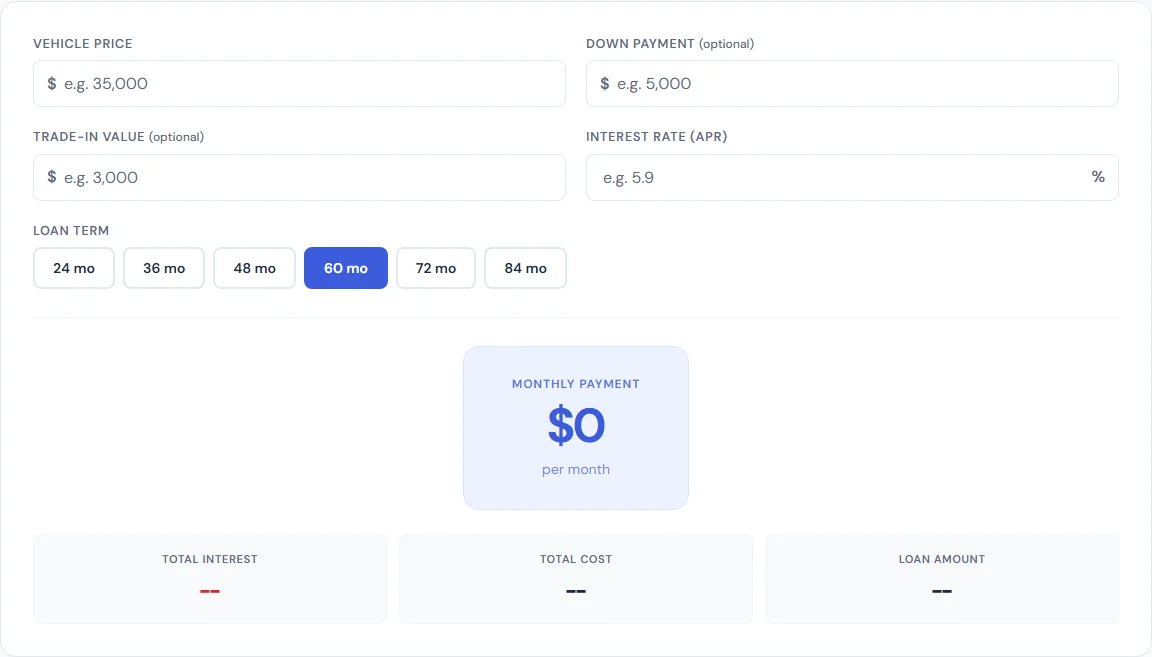
How Car Payments Are Actually Calculated
Every auto loan uses the same amortization formula. Understanding it takes the mystery out of what the dealership is doing with those numbers:
Monthly Payment = P × [r(1+r)n] / [(1+r)n − 1]
Where:
- P = Loan amount (vehicle price minus down payment and trade-in value)
- r = Monthly interest rate (annual APR divided by 12)
- n = Number of monthly payments (loan term in months)
Let's walk through a real example. Say you are buying a $35,000 car with $5,000 down, no trade-in, at 6.5% APR for 60 months:
- Loan amount: $35,000 − $5,000 = $30,000
- Monthly rate: 6.5% / 12 = 0.5417% (0.005417)
- Term: 60 months
- Monthly payment: $586.87
- Total interest paid: $5,212
- Total cost: $35,212
That $5,212 in interest is the true cost of borrowing. Now watch what happens when we change just one variable at a time.
How Loan Term Affects What You Pay
This is where dealerships make their money. A longer term lowers the monthly payment, which makes a more expensive car feel affordable. But it dramatically increases the total cost. Here is the same $30,000 loan at 6.5% APR across different terms:
| Loan Term | Monthly Payment | Total Interest | Total Cost |
|---|---|---|---|
| 36 months | $919 | $1,096 | $33,096 |
| 48 months | $711 | $4,146 | $34,146 |
| 60 months | $587 | $5,212 | $35,212 |
| 72 months | $505 | $6,339 | $36,339 |
| 84 months | $447 | $7,523 | $37,523 |
Look at the difference between 36 and 84 months: the monthly payment drops by $472, but you pay $6,427 more in interest. That is not a savings — it is a premium for the convenience of lower monthly payments. And there is a hidden cost not shown in this table: with an 84-month loan, you will be underwater (owing more than the car is worth) for roughly the first four years. If you need to sell or trade in during that time, you will have to write a check to cover the difference.
What Interest Rate Should You Expect?
Your interest rate depends primarily on your credit score, whether the car is new or used, and where you get the loan. Here are realistic ranges for 2026:
| Credit Score | New Car APR | Used Car APR |
|---|---|---|
| Excellent (750+) | 4.0–5.5% | 5.0–7.0% |
| Good (700–749) | 5.5–7.5% | 7.0–9.5% |
| Fair (650–699) | 7.5–11.0% | 9.5–14.0% |
| Poor (below 650) | 11.0–18.0% | 14.0–22.0%+ |
A critical point: the dealership's rate is rarely the best rate you can get. Before you set foot on a lot, get pre-approved through your bank or credit union. Credit unions in particular often beat dealership rates by 1 to 3 percentage points. On a $30,000 loan over 60 months, a 2% rate difference saves you roughly $1,600. That is $1,600 you keep simply by shopping for financing before shopping for the car.
How Much Car Can You Actually Afford?
There is a well-known rule called the 20/4/10 rule that financial advisors recommend:
- 20% — Put at least 20% down
- 4 — Finance for no more than 4 years (48 months)
- 10% — Keep total monthly transportation costs under 10% of gross monthly income
Total transportation costs means your car payment plus insurance, fuel, and maintenance. If your gross monthly income is $6,000, that is a $600 ceiling for everything car-related — not just the payment.
A simpler rule of thumb: your monthly car payment alone should not exceed 10–15% of your monthly take-home pay. If you bring home $4,500 after taxes, your payment should be $450 to $675 at most. Anything above that starts competing with housing, food, and savings for budget space.
If the car you want pushes you past these numbers, you have three options: save a larger down payment, choose a less expensive vehicle, or wait and improve your credit score to get a lower rate. None of those are as exciting as driving off the lot today, but all of them are better than six years of payments that strain your budget every month.
The Down Payment: Why It Matters More Than You Think
Putting money down on a car does four things simultaneously:
- Reduces your loan amount — less borrowed means less interest paid
- Lowers your monthly payment — without extending the term
- Protects you from being underwater — a new car loses 20% of its value the moment you drive it off the lot; a 20% down payment offsets that immediate depreciation
- Improves your interest rate — lenders see a larger down payment as lower risk and often offer better terms
Here is how different down payments affect a $35,000 car at 6.5% for 60 months:
| Down Payment | Loan Amount | Monthly Payment | Total Interest |
|---|---|---|---|
| $0 (0%) | $35,000 | $685 | $6,081 |
| $3,500 (10%) | $31,500 | $616 | $5,473 |
| $7,000 (20%) | $28,000 | $548 | $4,865 |
| $10,500 (30%) | $24,500 | $479 | $4,257 |
Going from $0 down to $7,000 down saves $137 per month and $1,216 in total interest. And more importantly, with 20% down you are never underwater — you could sell the car at any point and walk away without owing money.
5 Dealership Traps to Watch For
Dealerships are businesses, and their finance department is designed to maximize profit. Knowing these common tactics helps you negotiate from a position of strength.
1. The monthly payment focus
A salesperson will ask "What monthly payment are you looking for?" instead of discussing the total price. This lets them manipulate the term, rate, and price simultaneously to hit your target number while maximizing their profit. Always negotiate the total out-the-door price first, then discuss financing separately.
2. The rate markup
Dealerships buy your loan from a lender at one rate, then sell it to you at a higher rate, keeping the difference as profit. This is legal and extremely common. The markup is typically 1 to 3 percentage points. Your defense: arrive with a pre-approved offer from your bank or credit union. If the dealer can beat it, great. If not, use your own financing.
3. Extended warranties and add-ons
Extended warranties, paint protection, fabric coating, gap insurance, tire packages — these are presented in the finance office after you have already committed to buying the car. They add hundreds or thousands to your loan, spread across the monthly payment where they seem small. Most are heavily marked up and many are unnecessary. If you want gap insurance (which can be worthwhile), buy it from your auto insurance company for a fraction of the dealer's price.
4. The four-square worksheet
Some dealers use a paper worksheet with four boxes: trade-in value, purchase price, down payment, and monthly payment. By adjusting all four simultaneously, they create confusion about which terms are actually changing. Insist on negotiating one thing at a time: first the purchase price, then your trade-in value, then the financing terms.
5. Yo-yo financing
You sign papers, drive the car home, and a few days later the dealer calls to say your financing "fell through" and you need to come back to sign a new deal at a higher rate. This is sometimes legitimate, but it is also a known pressure tactic. Protect yourself by securing your own pre-approved financing before visiting the dealership. If you use dealer financing, do not consider the deal final until you receive written confirmation that the loan has been funded.
New vs Used: The Financial Reality
The math strongly favors used cars for most buyers. Here is why:
- Depreciation: A new car loses roughly 20% of its value in year one and about 15% per year after that. A three-year-old car has already absorbed the steepest depreciation, so you lose less value per year of ownership.
- Insurance: Comprehensive and collision coverage costs more for new cars because the replacement value is higher. Insurance on a 3-year-old model can be 20–30% cheaper.
- Registration: Many states base registration fees on the vehicle's value. A cheaper car means lower annual fees.
The sweet spot for value is typically a 2–3 year old certified pre-owned (CPO) vehicle. You avoid the worst depreciation hit, still get a manufacturer-backed warranty, and the car is recent enough to have modern safety features and technology. The interest rate will be slightly higher than a new car loan, but the lower purchase price more than makes up for it.
When It Makes Sense to Pay Cash
If you have the money, paying cash eliminates interest entirely — that is obvious. But there are cases where financing still makes sense even if you could pay cash:
- Very low interest rates (under 3–4%): If your money earns more invested than the loan costs, financing is mathematically better. But this only works if you actually invest the difference rather than spending it.
- Building credit: If you have thin credit history, a well-managed auto loan can help establish a strong payment history.
- Emergency fund preservation: If paying cash for a car would drain your savings below 3–6 months of expenses, it is safer to finance and keep the cash as an emergency buffer.
In all other cases, cash is king. Zero interest is the best interest rate.
Frequently Asked Questions
How much car can I afford?
A widely used guideline is the 20/4/10 rule: put at least 20% down, finance for no more than 4 years, and keep total monthly vehicle costs (payment, insurance, gas, maintenance) under 10% of your gross monthly income. A simpler version: your monthly car payment alone should not exceed 10–15% of your monthly take-home pay.
What is a good interest rate for a car loan in 2026?
For new cars, borrowers with excellent credit (750+) can expect rates between 4% and 6% APR. Good credit (700–749) typically sees 6% to 8%. Fair credit (650–699) may get 8% to 12%. Used car rates run 1 to 2 percentage points higher across all credit tiers. Credit unions often offer the best rates.
Is a longer car loan term always a bad idea?
Not always, but usually. A 72- or 84-month loan lowers your monthly payment, but you pay significantly more in total interest and risk being underwater (owing more than the car is worth) for most of the loan. If you need a longer term to afford the payment, it is a strong signal that the car is too expensive for your budget.
Should I put a down payment on a car?
Yes. A down payment of at least 10–20% reduces your loan amount, lowers your monthly payment, reduces total interest, and helps you avoid being upside down on the loan. It also signals to lenders that you are a lower risk, which can help you qualify for a better interest rate.
How is a monthly car payment calculated?
Monthly car payments use the standard amortization formula: M = P[r(1+r)n]/[(1+r)n−1], where P is the loan amount (vehicle price minus down payment and trade-in), r is the monthly interest rate (annual rate divided by 12), and n is the total number of monthly payments. This formula ensures each payment covers both interest and principal in a fixed amount.
BLIPP built SmarterSources to replace expensive subscriptions with free, private tools. Every tool runs in your browser — no sign-ups, no limits.