How to Plan a Wedding on a Budget — Free Tools and Templates

The average US wedding costs around $35,000 in 2026. That number shows up in every article, every vendor pitch, and every well-meaning family conversation. It can make the entire idea of planning a wedding feel like signing up for years of debt before you even pick a date.
But here is the good news: that average is heavily skewed by high-end weddings in expensive cities. The median wedding cost is closer to $10,000–$15,000, and millions of couples every year pull off meaningful, beautiful celebrations without spending anywhere near the national average. The difference between couples who overspend and those who stay on track almost always comes down to one thing: having a plan.
With the right tools and a clear budget, you can make informed decisions at every step instead of reacting to vendor quotes and social media pressure. This guide breaks down where wedding money actually goes, how to allocate your budget by category, and how to use free planning tools to stay organized from engagement to the last dance.
Ready to start planning? Set up your wedding budget in minutes.
Open the Wedding Budget Planner →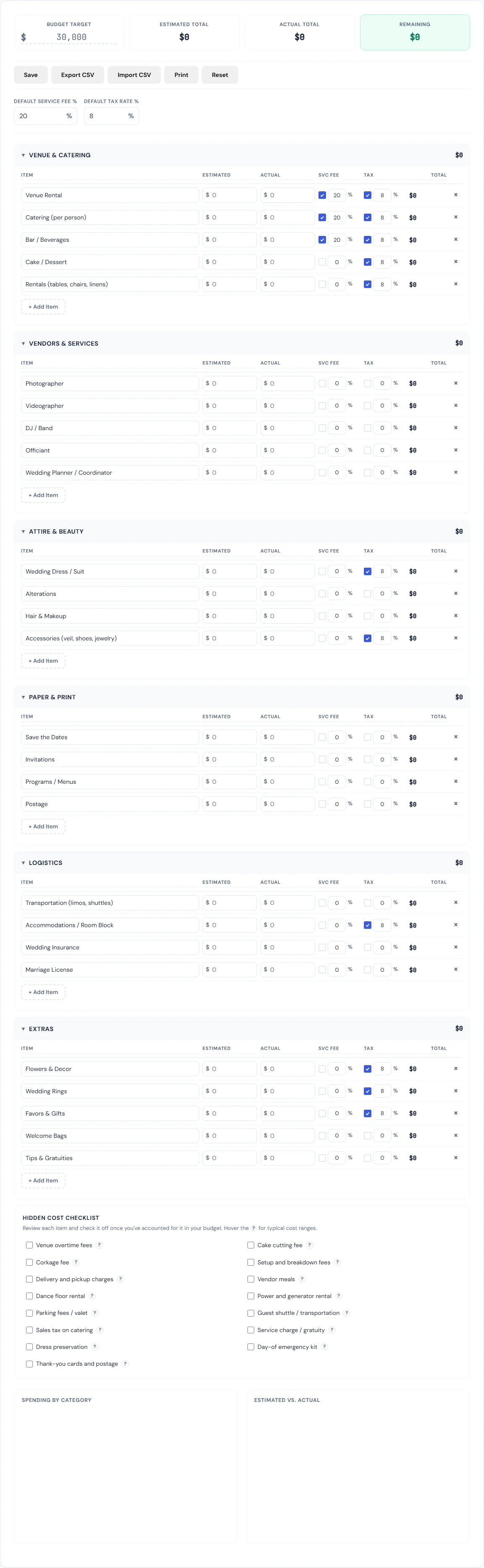
How Much Does a Wedding Really Cost?
The often-cited $35,000 national average comes from industry surveys that tend to oversample couples who use premium wedding planning platforms. These surveys capture vendor-heavy weddings in major metro areas but undercount courthouse ceremonies, backyard receptions, and destination micro-weddings.
When researchers look at broader data sets, the picture shifts significantly. The median US wedding cost sits around $10,000 to $15,000. That means half of all couples spend less than that number, and many spend far less. Regional variation is enormous: a 150-guest wedding in Manhattan can easily run $70,000 or more, while the same guest count in a mid-size Southern city might come in under $20,000.
The most important statistic, though, is this one: most couples spend more than they originally planned. The reason is not reckless spending. It is a lack of visibility. When you do not have a detailed budget with line items, deposits, and running totals, every vendor conversation becomes a separate negotiation with no anchor. You say yes to the upgraded linens because you have no idea whether your floral budget already absorbed that money.
The single most impactful thing you can do is set your total budget before you contact a single vendor. Write the number down. Build your category allocations around it. Then track every dollar against that plan as deposits and payments come due.
Wedding Budget Breakdown by Category
Every wedding is different, but decades of industry data point to fairly consistent spending patterns. Here is a typical allocation breakdown you can use as a starting framework and adjust to your priorities:
- Venue & Catering: 40–50% — This is almost always the largest single line item. It includes the venue rental fee, food, beverages, service staff, and often tables, chairs, and linens.
- Photography & Videography: 10–12% — Professional photos are one of the few things that last beyond the wedding day. Many couples rank this as their highest-priority spend after the venue.
- Music & Entertainment: 5–8% — A live band costs significantly more than a DJ, who costs more than a curated playlist. Decide early which matters to you.
- Flowers & Decor: 8–10% — Centerpieces, bouquets, boutonnieres, ceremony arch, and any additional decorative elements. This category is one of the easiest to scale up or down.
- Attire & Beauty: 5–8% — Wedding dress or suit, alterations, shoes, accessories, hair, and makeup for the wedding party.
- Stationery & Invitations: 2–3% — Save-the-dates, invitations, RSVP cards, programs, menus, and thank-you cards. Digital invitations can cut this to nearly zero.
- Officiant & License: 1–2% — Marriage license fee plus officiant fee or honorarium.
- Transportation: 2–3% — Shuttle service for guests, limo or car service for the couple, parking arrangements.
- Favors & Gifts: 2–3% — Guest favors, wedding party gifts, parent gifts, and vendor tips.
- Contingency: 5–10% — This is the line item most couples skip and most planners insist on. Unexpected costs will come up. A contingency fund keeps them from derailing your budget.
These percentages are guidelines, not rules. If live music is the most important thing to you, shift budget from flowers and favors. If you found a stunning free venue through family, reallocate that 40% across other categories. The percentages exist to prevent any single category from quietly consuming your entire budget.
How to Use the Wedding Budget Planner
The Wedding Budget Planner on SmarterSources is designed for exactly this workflow. It runs entirely in your browser with no account required, and your data stays on your device.
Start by entering your total wedding budget at the top. Then add categories — venue, photography, attire, and so on — with an estimated budget for each. As you book vendors and make payments, add those amounts to each category. The planner tracks your deposits and remaining balances, shows you the percentage of your total budget each category represents, and flags when you are approaching or exceeding a category limit.
You can adjust service fee percentages and tax rates to match your region, which gives you a more accurate picture of total costs than the base vendor quotes alone. Many couples are surprised by how much service charges and sales tax add to their catering bill, for example.
When you need to share your budget with a partner, parent, or planner, export the entire thing as a CSV file. It opens in Excel, Google Sheets, or any spreadsheet app. You can also import a CSV back in, which makes it easy to collaborate: one person exports, the other reviews and re-imports with updates.
Everything saves automatically to your browser's local storage, so you can close the tab and come back days later without losing anything. For an extra layer of safety, export a CSV backup after each major update.
Managing Your Guest List
If there is one number that drives your wedding budget more than any other, it is the guest count. Every additional guest adds to catering costs, seating needs, invitation printing, and favor quantities. A 200-guest wedding does not cost twice as much as a 100-guest wedding — it often costs significantly more than twice as much, because venue size, staffing ratios, and logistics all scale non-linearly.
The challenge is that guest lists are rarely straightforward. You have your initial list, but then each guest might bring a plus-one. Some families will bring children. And not everyone who receives an invitation will attend. Getting an accurate headcount estimate early in the planning process helps you choose the right venue size, get accurate catering quotes, and order the right number of invitations.
The Plus One Calculator helps you work through this math. Enter your base guest count, specify how many guests get plus-one privileges, estimate how many children will attend, and set an expected RSVP acceptance rate. The tool calculates your likely total headcount so you can plan (and budget) accordingly.
A good rule of thumb: assume an 80–85% attendance rate for local guests and 40–60% for out-of-town guests. These numbers vary, but they give you a realistic planning range that is more useful than assuming everyone will show up.
Counting Down to the Big Day
Wedding planning is not a single event — it is a 6-to-18-month project with dozens of deadlines. Missing a venue deposit date or sending invitations late can cascade into bigger problems and higher costs. Keeping track of key milestones helps you stay ahead of deadlines instead of scrambling to catch up.
The Countdown Timer is a simple way to keep your next deadline front and center. Set countdowns for the milestones that matter most:
- Venue booking deadline — Popular venues fill up 12–18 months in advance. Lock this in early.
- Invitation send date — Mail invitations 6–8 weeks before the wedding, earlier for destination weddings.
- Final vendor payments — Most vendors require final payment 2–4 weeks before the event.
- RSVP deadline — Set this 3–4 weeks before the wedding to give you time to finalize seating and catering numbers.
- Rehearsal dinner — Usually the evening before the wedding.
- The wedding day itself — Because watching the countdown hit zero is one of the best feelings in the planning process.
15 Ways to Save Money on Your Wedding
Cutting costs does not mean cutting corners. These are practical strategies that real couples use to keep their weddings beautiful and their bank accounts intact:
- Book off-peak. Friday evenings, Sunday brunches, and winter months are significantly cheaper than Saturday nights in June. Some venues offer 30–50% discounts for off-peak dates.
- Limit the guest list. This is the single biggest savings lever you have. Every guest you cut saves you $100–$300 or more in per-person costs.
- Choose a non-traditional venue. Parks, family properties, restaurants with private dining rooms, community centers, and botanical gardens often cost a fraction of dedicated wedding venues.
- Use seasonal, local flowers. Out-of-season blooms need to be imported and cost significantly more. Ask your florist what is blooming locally around your wedding date.
- DIY invitations and programs. High-quality card stock and a good printer can produce beautiful invitations. Or go fully digital with email invitations and a wedding website.
- Skip the videographer or use a friend with good equipment. Professional videography is a luxury, not a necessity. A friend with a decent camera and a tripod can capture the ceremony and key moments.
- Buy a dress secondhand or off-the-rack. Sample sales, consignment shops, and online resale platforms offer designer gowns at 50–80% off retail. Many have been worn once or never at all.
- Limit the bar. Beer and wine only, or two signature cocktails, costs dramatically less than a full open bar. Guests rarely notice or mind.
- Use a playlist instead of a DJ for ceremony and cocktail hour. Save the DJ or band for the reception. A well-curated playlist through a good speaker system works perfectly for the earlier parts of the day.
- Order a small cutting cake plus sheet cake from a bakery. A gorgeous two-tier display cake for photos plus sheet cake sliced in the kitchen for guests costs half of what a full tiered cake for 150 people runs.
- Negotiate vendor packages. Many vendors offer bundled discounts. A photographer who also does engagement shoots might give you a better rate for both. Ask about packages before accepting the first quote.
- Skip the favors. Studies consistently show that 50–70% of wedding favors get left behind on the table. Save the $3–$10 per guest and put it toward something guests will actually enjoy, like better food or a longer open bar window.
- Use free tools instead of paid wedding planning apps. Premium wedding planning subscriptions charge $10–$30 per month for features you can get for free. Our Wedding Budget Planner, Plus One Calculator, and Countdown Timer cover the essentials without a subscription.
- Get married at the venue. Holding both the ceremony and reception at the same location eliminates the cost of a separate ceremony venue, guest transportation between locations, and the logistical headaches of moving everyone.
- Set a firm contingency fund and do not touch it until you need it. A 5–10% contingency fund is not wasted money. It is the buffer that keeps one unexpected cost from blowing up your entire budget. Only dip into it for genuine surprises, not upgrades.
Frequently Asked Questions
How much should I budget for a wedding?
There is no single right number. The national average is around $35,000, but the median is $10,000–$15,000. Start with what you can comfortably afford without going into debt, then allocate from there. A wedding you can pay for in full is always better than a more expensive wedding that takes years to pay off.
Who traditionally pays for what at a wedding?
Traditional etiquette says the bride's family covers the ceremony, reception, and flowers, while the groom's family pays for the rehearsal dinner, officiant fee, and honeymoon. In practice, modern couples split costs in whatever way works for their situation. Many couples pay for the majority themselves, with family contributions filling in gaps. Have an honest conversation about money early in the planning process.
How far in advance should I start planning?
Most wedding planners recommend 12–18 months for a full-scale wedding. If you are flexible on venue and date, 6–9 months is workable. The venue and photographer are typically the first two vendors to book because they fill up the fastest. Start budgeting and researching venues as soon as you have a rough date range and guest count in mind.
What is the biggest unexpected wedding cost?
Service charges and gratuities are consistently the most surprising line items. Many venue contracts include a 20–22% service charge on food and beverage, and that charge is often taxable. On a $15,000 catering bill, the service charge and tax alone can add $4,000–$5,000. Always ask vendors for all-in pricing that includes service fees, tax, and gratuity so you can compare quotes accurately.
Can I really plan a wedding for under $10,000?
Absolutely. Couples do it every year. The keys are a smaller guest list (under 50), a non-traditional venue (park, family property, restaurant), DIY where it makes sense (invitations, decor, music), and prioritizing the two or three things that matter most to you. A $10,000 budget with clear priorities produces a better wedding experience than a $30,000 budget spent reactively.
BLIPP built SmarterSources to replace expensive subscriptions with free, private tools. Every tool runs in your browser — no sign-ups, no limits.