How to Plan Your Wedding Budget Without Overspending

The average wedding in the United States costs over $30,000. That number comes up in every wedding planning article, and it scares a lot of couples. But here is the thing: averages are misleading. Some couples spend $5,000. Others spend $150,000. What matters is not how much other people spend. What matters is how much you can spend without starting married life under financial stress.
The most common reason couples overspend on their wedding is not extravagance. It is hidden costs they never saw coming. Service fees, overtime charges, gratuities, alterations, extra meals for vendors, cake-cutting fees—these line items add up quietly and can push a seemingly reasonable budget 20–30% over target.
This guide walks through how to build a wedding budget that accounts for everything, with a free tool that does the math for you.
Want to start planning your wedding budget now? The tool is free and tracks every dollar.
Plan Your Budget →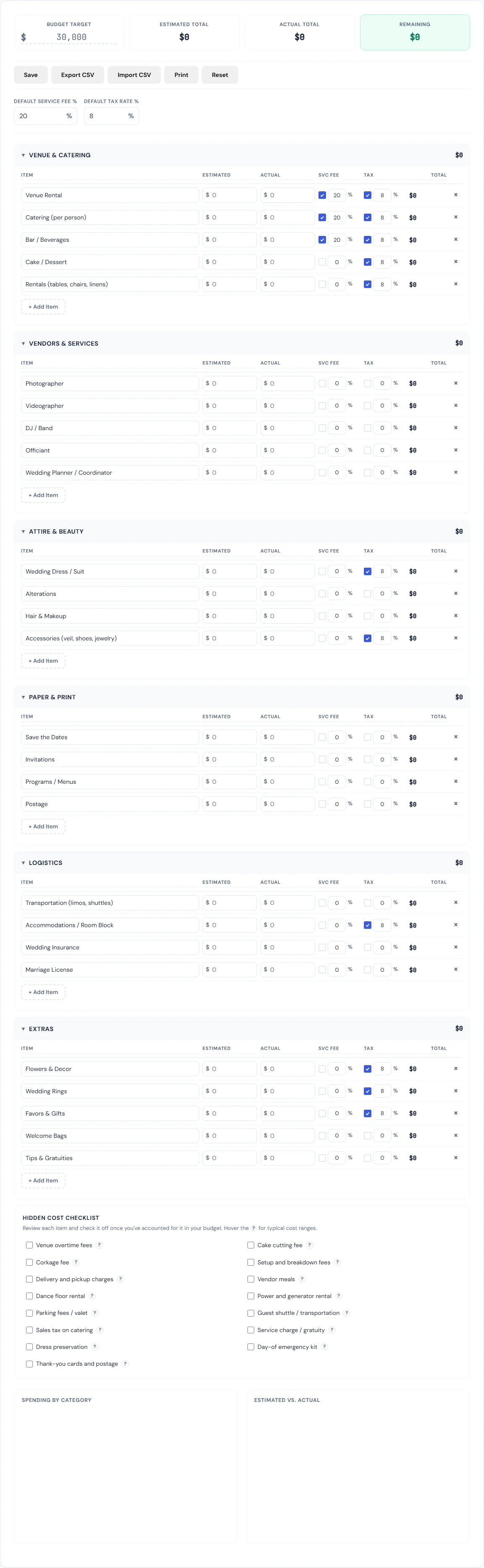
Start With What You Can Actually Spend
Before you look at venues, dresses, or Pinterest boards, sit down and figure out your total number. This means:
- Your savings. How much have you and your partner set aside specifically for the wedding?
- Family contributions. If parents or relatives are contributing, get specific numbers in writing. "We will help" is not a budget line item.
- Monthly savings runway. If the wedding is 12 months out and you can save $500/month, that is another $6,000.
Add those up. That is your total budget. Write it down and commit to it. Everything else flows from this number.
The Standard Allocation Breakdown
Wedding industry data consistently shows similar spending patterns across budget sizes. Here is a typical allocation that works as a starting point:
- Venue & catering: 40–50% — This is almost always the single largest expense. It includes the venue rental, food, drinks, and often tables, chairs, and linens.
- Photography & videography: 10–15% — Photos are the one thing couples consistently say they are glad they invested in. They last forever.
- Music & entertainment: 5–10% — DJ, band, photo booth, or other entertainment.
- Flowers & decor: 8–10% — Centerpieces, ceremony flowers, bouquets, and decorative rentals.
- Attire & beauty: 5–10% — Wedding dress or suit, alterations, shoes, hair, and makeup.
- Stationery & invitations: 2–3% — Save-the-dates, invitations, programs, menus, and place cards.
- Transportation: 2–3% — Guest shuttles, bridal car, parking.
- Favors & gifts: 2–3% — Guest favors, wedding party gifts, parent gifts.
- Contingency: 5–10% — This is non-negotiable. You will need it.
These percentages are guidelines, not rules. If live music is your top priority, take from flowers or favors. If you found a stunning all-inclusive venue, your venue percentage may be higher but your decor and catering costs drop. The key is that every dollar is accounted for before you start signing contracts.
The Hidden Costs That Blow Budgets
This is where most wedding budgets fall apart. You book a venue for $8,000, sign the contract, and then discover the real number is closer to $11,000 after fees. Here are the hidden costs to watch for:
Service Charges and Gratuities
Most venues add a 18–22% service charge on top of the quoted food and beverage price. This is not a tip—it goes to the venue. You may also be expected to tip the catering staff, bartenders, and coordinator separately. On a $10,000 catering bill, that is $1,800–$2,200 in service charges alone, plus another $500–$1,000 in gratuities.
Sales Tax
Some venues include tax in their quotes. Many do not. Depending on your state, sales tax on food and services can add 6–10% to every vendor bill. Ask every vendor whether their quote includes tax.
Overtime Fees
Your reception is scheduled for five hours. At hour four, the dance floor is packed and no one wants to leave. Extending by one hour might cost $1,000–$2,000 for the venue, plus overtime for the DJ, photographer, and bartenders. Budget for at least one hour of overtime.
Vendor Meals
Your photographer, videographer, DJ, and wedding coordinator need to eat. Most venues charge $30–$75 per vendor meal. For four vendors, that is $120–$300 you may not have planned for.
Dress Alterations
The price tag on the dress is just the starting point. Alterations typically run $200–$800 depending on complexity. Bustling, hemming, and taking in the bodice are almost always needed.
Cake-Cutting Fees
If you bring in an outside cake (not from the venue's caterer), some venues charge a $1–$3 per-slice cake-cutting fee. For 150 guests, that is $150–$450 for the privilege of someone slicing a cake.
Marriage License and Officiant
The license fee varies by state ($20–$100), and if you hire an officiant, expect $200–$800. These are small individually but add up with everything else.
A good rule of thumb: take any vendor's initial quote and mentally add 20%. If the final number is still within your budget, you are in good shape.
How to Track It All Without Going Crazy
Spreadsheets work, but they require discipline. You have to remember to update them, add formulas for taxes and fees, and reconcile estimates against actual payments as deposits come due. Most couples start with a spreadsheet and stop updating it around month three.
We built the Wedding Budget Planner specifically to solve this problem. Here is what it does:
- Pre-built categories with common line items. Venue, catering, photography, flowers, attire, music—every major category comes pre-loaded with the line items most couples need. You do not have to remember what to budget for.
- Automatic service fee and tax calculations. Enter your service charge percentage and tax rate once. The tool applies them automatically to every vendor in that category. No more manual math.
- Hidden cost warnings. The tool flags categories where hidden costs are common and reminds you to account for them.
- Estimated vs. actual tracking. Enter your estimated budget for each item, then update with actual costs as you sign contracts and make payments. The tool shows the difference so you always know where you stand.
- Visual charts. See your spending breakdown by category in a donut chart, and compare estimated vs. actual spending in a bar chart.
- CSV export. Download your entire budget as a spreadsheet to share with your partner, parents, or wedding coordinator.
Everything runs in your browser and saves to your device. No account, no subscription, no one else seeing your financial details.
Quick Budget vs. Detailed Budget
If you are just starting out and want a fast overview, the Quick Wedding Budget Calculator lets you plug in your total budget and see a category breakdown in seconds. It covers 10+ major categories with a visual donut chart. Use it to get a rough feel for where your money will go.
When you are ready to get granular—tracking individual vendor contracts, deposits, service fees, and actual payments—switch to the full Wedding Budget Planner.
Not sure how much to allocate to each category? The Wedding Budget Recommender takes your total budget, wedding style (intimate, classic, or luxury), and region, then generates personalized spending allocations with per-person costs.
Tips That Actually Save Money
Negotiate Everything
Vendor pricing is rarely fixed. Ask about off-peak discounts (Friday or Sunday weddings can be 20–40% cheaper), package deals, and whether they will match a competitor's price. The worst they can say is no.
Prioritize Two or Three Things
Decide as a couple what matters most. Maybe it is the food and the photographer. Maybe it is the band and the venue. Put your money there and go minimal everywhere else. Guests remember the food and the dancing, not the napkin rings.
Cut the Guest List Before Cutting Quality
Every additional guest costs $100–$300 in food, drinks, rentals, and favors. Cutting 20 guests saves $2,000–$6,000. That is often more impactful than downgrading vendors.
DIY Strategically
DIY works for some things (welcome signs, favors, table numbers) and backfires for others (flowers, hair and makeup, anything time-sensitive on the day of). Only DIY items you can finish well in advance and that will not stress you out the week of the wedding.
Use the Contingency Fund
That 5–10% buffer is there to absorb surprises without derailing everything else. If you do not use it, congratulations—you have extra money for the honeymoon.
Get Started
Open the Wedding Budget Planner, enter your total budget, and start filling in estimates. The tool handles the service fees, tax, and math. Export your budget as a CSV anytime to share or back up. Everything stays private in your browser.
If you want a faster starting point, try the Wedding Budget Recommender first to see how your budget should be allocated based on your wedding style and region, then transfer those numbers into the detailed planner.
BLIPP built SmarterSources to replace expensive subscriptions with free, private tools. Every tool runs in your browser — no sign-ups, no limits.