Pomodoro Technique: The Complete Guide to Focus and Productivity

The average knowledge worker is interrupted every 11 minutes. Once interrupted, it takes roughly 23 minutes to regain full concentration. Do the math and the picture is bleak: most people never reach a state of deep focus during a standard workday. They skim the surface of their tasks, context-switching between email, chat notifications, and half-finished projects, ending each day exhausted but uncertain about what they actually accomplished.
Attention fragmentation is not a willpower problem. It is an environment problem. Modern work tools are designed to pull your focus in every direction at once. Without a system to protect your concentration, you will lose it to the loudest notification in the room.
The Pomodoro Technique is one of the most effective systems ever developed for sustained, deliberate focus. Created by Francesco Cirillo in the late 1980s while he was a university student struggling to concentrate, the method uses a simple kitchen timer — his was shaped like a tomato, hence the name — to structure work into focused intervals separated by mandatory breaks. It is free, requires no special tools, and has been used by millions of students, writers, developers, and professionals worldwide.
Ready to try it? Start a free Pomodoro session right now.
Start the Pomodoro Timer →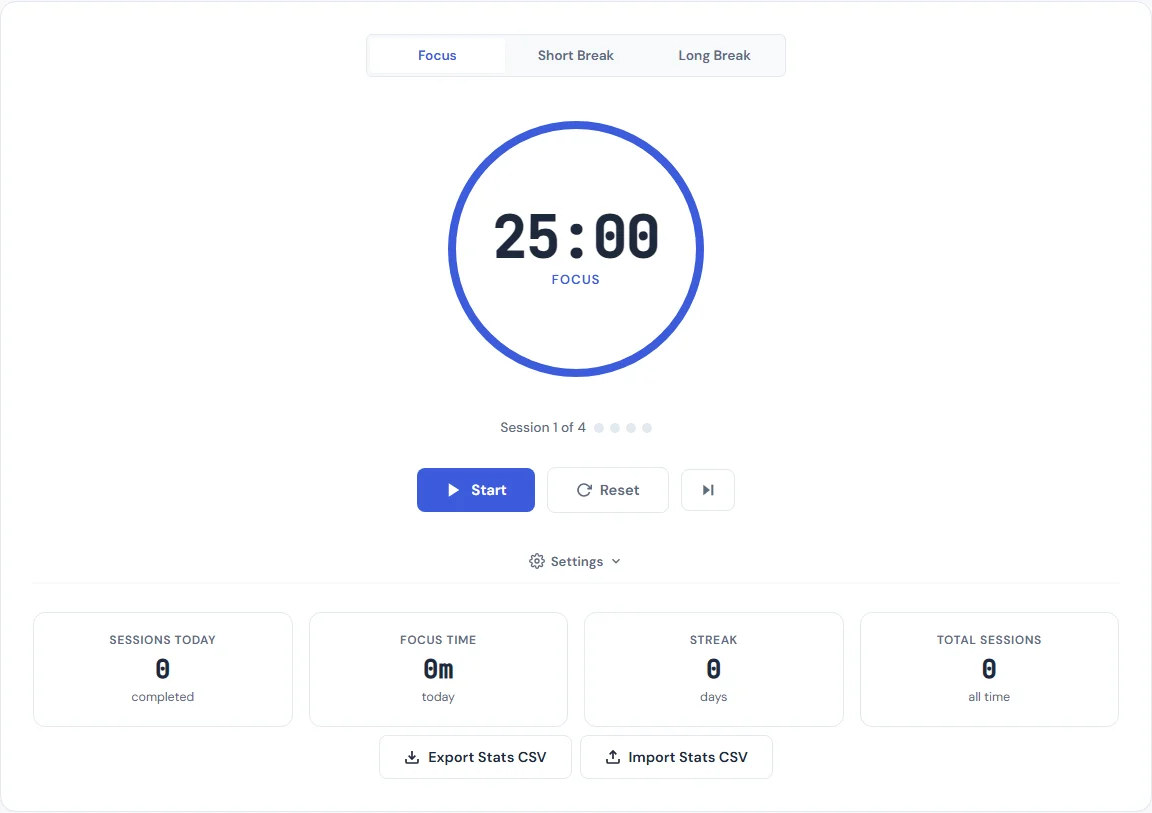
What Is the Pomodoro Technique?
In 1987, Francesco Cirillo was a first-year university student in Rome, overwhelmed by coursework and unable to focus for more than a few minutes at a time. He made a bet with himself: could he study with true concentration for just ten minutes? He grabbed the nearest timer he could find — a tomato-shaped kitchen timer — and set it. That small experiment became the foundation of the Pomodoro Technique.
The core concept is deceptively simple. You work in structured intervals, traditionally 25 minutes long, called "pomodoros" (the Italian plural of tomato). Each pomodoro is a single, unbroken unit of focused work. When the timer rings, you stop — regardless of where you are in the task — and take a short break. After four pomodoros, you take a longer break. Then you start again.
The brilliance is in the constraints. The timer creates urgency. The breaks prevent burnout. The counting gives you a tangible measure of how much focused work you actually did. Instead of vaguely "working on the report for three hours" (most of which was spent checking email), you completed six pomodoros. That is a real, measurable quantity of deep work.
How It Works: The 5-Step Process
The Pomodoro Technique follows a straightforward five-step cycle. Each step serves a specific purpose, and skipping any of them undermines the system.
Step 1: Choose a task. Before you start the timer, decide exactly what you will work on during this pomodoro. "Work on the project" is too vague. "Write the introduction section of the quarterly report" is specific. Clarity eliminates the decision fatigue that eats into your focused time. If you have multiple tasks, write them down and pick one. You can switch between pomodoros, but never during one.
Step 2: Set the timer for 25 minutes. Use a physical timer, a phone app, or a browser-based Pomodoro timer. The important thing is that the timer is visible or audible so you do not have to check the clock. Checking the clock is a micro-interruption. Let the timer do its job.
Step 3: Work until the timer rings. This is the non-negotiable part. For 25 minutes, you do nothing except the task you chose. No email. No messages. No "quick" web searches. If something urgent comes up, write it on a piece of paper and return to your task. If someone interrupts you, tell them you will be available in a few minutes. The pomodoro is sacred.
Step 4: Take a 5-minute break. When the timer rings, stop immediately. Even if you are mid-sentence. Even if you are "almost done." Stand up, stretch, get water, look out a window. Do not check your phone or read email — these are not breaks, they are attention traps disguised as breaks. A real break means disengaging your working mind.
Step 5: After four pomodoros, take a 15 to 30-minute break. This longer break allows your brain to process and consolidate what you have been working on. Take a walk, eat a snack, have a conversation. When you return, you start a new set of four pomodoros.
The Science Behind Timed Work Sessions
The Pomodoro Technique was invented through intuition, but decades of neuroscience and psychology research have since validated its core principles.
Attention spans are finite. Research on sustained attention consistently shows that focus degrades over time. A 2011 study by Ariga and Lleras at the University of Illinois found that brief diversions from a task dramatically improved the ability to focus on that task for prolonged periods. The researchers called it "vigilance decrement" — the longer you stare at something without interruption, the worse your brain gets at processing it. Short breaks reset this decline.
Cognitive fatigue is real and cumulative. Decision-making, problem-solving, and creative thinking all draw from the same limited pool of mental energy. Working without breaks does not just make you less focused — it makes you worse at the actual thinking required by your work. The decisions you make at hour four of unbroken work are measurably worse than the decisions you made at hour one.
Ultradian rhythms govern your energy. Your body operates on cycles of roughly 90 to 120 minutes of higher alertness followed by 20 minutes of lower alertness. These ultradian rhythms run throughout the day. The Pomodoro structure of approximately two hours of work (four 25-minute pomodoros plus breaks) followed by a longer rest period aligns naturally with these biological cycles.
Breaks consolidate memory. Neuroscience research shows that the brain continues processing information during rest periods. A 2010 study published in Neuron found that wakeful rest after learning significantly improved memory retention. The short breaks between pomodoros are not wasted time — they are when your brain encodes what you just worked on.
Flow state is valuable but unsustainable. Many people resist the idea of stopping when they are "in the zone." But flow states, while productive, are also exhausting. Unmanaged flow leads to burnout, not sustainable productivity. The Pomodoro Technique does not prevent flow — it prevents the crash that follows unregulated deep work.
Customizing Your Intervals
The traditional 25/5 split is a starting point, not a rule. Cirillo chose 25 minutes because it was long enough to make meaningful progress but short enough that even a distracted university student could commit to it. Your ideal interval depends on the type of work you do and your personal attention patterns.
50/10 for deep, creative work. Writers, programmers, and designers often find that 25 minutes is too short for tasks that require a long ramp-up time. If it takes you ten minutes to get into a complex codebase, a 25-minute pomodoro gives you only 15 minutes of productive work. Switching to 50-minute work blocks with 10-minute breaks doubles your uninterrupted time. Many experienced Pomodoro users graduate to this schedule.
15/3 for tedious or administrative tasks. Data entry, email triage, expense reports — tasks that are boring but necessary benefit from shorter intervals. Fifteen minutes of focused email processing feels manageable. Forty-five minutes feels like punishment. Shorter pomodoros make unpleasant tasks bearable by keeping the finish line always in sight.
90/20 for research and analysis. If your work involves reading dense material, analyzing data, or writing long-form content, a 90-minute block mirrors the natural ultradian rhythm and allows you to reach the deep engagement that complex analysis requires. Follow it with a full 20-minute break to recover.
Our Pomodoro Timer lets you customize work duration, short break length, long break length, and the number of sessions before a long break. Experiment until you find the rhythm that matches your work and attention style.
Who Benefits Most
Students studying for exams. The Pomodoro Technique transforms marathon study sessions into structured, measurable blocks. Instead of "studying all day" and retaining almost nothing, you complete 8 to 12 pomodoros and know exactly how much focused work you put in. Pair it with flashcards and spaced repetition for maximum retention.
Writers and content creators. Blank-page paralysis dissolves when you only have to write for 25 minutes. You do not need to write a great chapter. You just need to write until the timer rings. This reframing removes the psychological weight of the entire project and replaces it with a single, concrete action: write for 25 minutes.
Software developers. Coding in focused sprints with defined break points reduces bugs, improves code quality, and prevents the tunnel vision that leads to hours wasted on an approach that should have been abandoned thirty minutes in. The break between pomodoros is a natural moment to step back and evaluate your approach.
Remote workers. Without the structure of an office — no commute, no meetings to segment the day, no coworkers to signal lunchtime — remote work can feel like one long, undifferentiated blur. The Pomodoro Technique provides the time structure that an office provides passively. It tells you when to work, when to rest, and when to stop.
Anyone with focus challenges. If you struggle with attention, whether due to ADHD, anxiety, or simply an overwhelming workload, the Pomodoro Technique reduces the task from "focus all day" to "focus for 25 minutes." That is a fundamentally different challenge. Most people can focus for 25 minutes. And 25 minutes of real focus accomplishes more than three hours of distracted half-work.
Tips for Getting the Most Out of Pomodoro
Work on one task per pomodoro. Multitasking within a pomodoro defeats the purpose. Choose one task before starting the timer and do not switch. If you finish early, use the remaining time to review or refine your work. If the task spans multiple pomodoros, that is fine — just do not mix tasks within a single session.
If interrupted, note it and return. Keep a sheet of paper next to your workspace. When a thought pops into your head ("I need to reply to that email," "I should check the weather"), write it down in two or three words and immediately return to your task. The paper captures the thought so your brain can let go of it. Process the list during your break.
Start with easy tasks to build momentum. If you are new to the technique or having a low-energy day, begin with a simple task for your first pomodoro. Completing a full pomodoro creates momentum and confidence. Once you are in the rhythm, tackle the harder work.
Batch similar tasks. Group related activities into consecutive pomodoros. If you have four emails to draft, do them in one or two pomodoros rather than scattering them throughout the day. Context-switching between different types of work is expensive. Batching minimizes it.
Track completed pomodoros. Keep a simple tally of how many pomodoros you complete each day. This gives you an honest picture of your productive output. Most people are surprised to find that even a "busy" day might only contain four or five pomodoros of actual focused work. That awareness alone is valuable.
Respect the breaks. The breaks are not optional. They are part of the system. Skipping breaks to "power through" leads to diminishing returns within an hour and exhaustion by afternoon. A five-minute break feels like lost time in the moment but saves you from the two-hour productivity crash that comes from working without rest.
Dealing with Interruptions
Interruptions are the biggest threat to a successful Pomodoro practice. They come in two forms, and each requires a different strategy.
External interruptions are caused by other people: a coworker asking a question, a phone call, a family member entering your workspace. For these, Cirillo recommends the "inform, negotiate, call back" strategy. Inform the person you are in the middle of something. Negotiate a time to address their need ("Can I come find you in 15 minutes?"). Then call back — actually follow up during your break or after the current pomodoro. Most interruptions are not truly urgent. The ones that are will not wait for your negotiation anyway.
Internal interruptions come from your own mind: a sudden urge to check social media, a worry about an unrelated task, a "brilliant idea" for a different project. These are more insidious because there is nobody to negotiate with. The solution is the paper method described above. Write the thought down. Do not engage with it. Return to your task. Your brain generates these interruptions because it is trying to avoid the effort of sustained focus. Acknowledging the thought (by writing it) without acting on it trains your brain that not every impulse requires immediate action.
If an interruption completely derails your pomodoro — you spend more than a minute dealing with it — the pomodoro does not count. Void it and start a new one. This is not a punishment. It is data. If you are voiding multiple pomodoros per day, that tells you something important about your environment. Maybe you need to close your office door, put on headphones, or have a conversation with the people who keep interrupting you.
Frequently Asked Questions
What if my task takes less than 25 minutes?
If you finish a task before the timer rings, use the remaining time for a related activity: review your work for errors, plan the next step, or start a small follow-up task. The goal is to stay in focused mode until the break. Over time, you will get better at estimating how many pomodoros a task requires and can group smaller tasks together into a single session.
What if I am in flow and do not want to stop?
This is the most common objection to the Pomodoro Technique, and it is understandable. The short answer: take the break anyway. Flow feels great in the moment, but unregulated flow leads to cognitive depletion. You will pay for those extra 30 minutes with reduced performance for the rest of the day. The break protects your ability to do more high-quality work later. That said, if you are consistently hitting flow at the 25-minute mark, consider switching to 50-minute pomodoros so the break falls at a more natural stopping point.
Can I use the Pomodoro Technique for meetings?
Not directly, since meetings involve other people and their own time constraints. However, you can apply the principle. If you are leading a meeting, try structuring it in 25-minute segments with clear agendas. A meeting that runs 25 minutes with a defined goal will accomplish more than an hour-long meeting that drifts between topics. You can also use a countdown timer to keep meeting segments on track.
Is 25 minutes scientifically optimal?
There is no single "optimal" interval backed by research. Twenty-five minutes is effective because it is short enough to feel achievable and long enough to produce meaningful progress. Studies on attention and vigilance suggest that focus begins to degrade after 20 to 50 minutes depending on the individual and the task. The 25-minute default is a solid middle ground, but the best interval is the one you will actually use consistently.
Does the Pomodoro Technique work for creative work?
Yes, and many creative professionals consider it essential. Creativity thrives on constraints. Knowing you only have 25 minutes silences the inner critic that says the work is not good enough — you do not have time for that voice. You just have time to create. Many writers, designers, and musicians use longer intervals (50 or 90 minutes) for creative sessions, but the principle is the same: bounded time creates productive urgency.
BLIPP built SmarterSources to replace expensive subscriptions with free, private tools. Every tool runs in your browser — no sign-ups, no limits.