How to Study Smarter, Not Harder — The Science of Spaced Repetition and Active Recall

Most students study by re-reading their notes. They highlight key passages, review the same slides three times, and feel confident walking into the exam. Then they blank on the second question.
This is not a discipline problem. It is a method problem. Decades of cognitive science research have identified two techniques that dramatically outperform every other study method: spaced repetition and active recall. They are not new, they are not complicated, and they do not require expensive software. But most students have never heard of them.
Ready to build a study system that actually works? Start by creating flashcards you can review on a schedule.
Create Your Flashcards →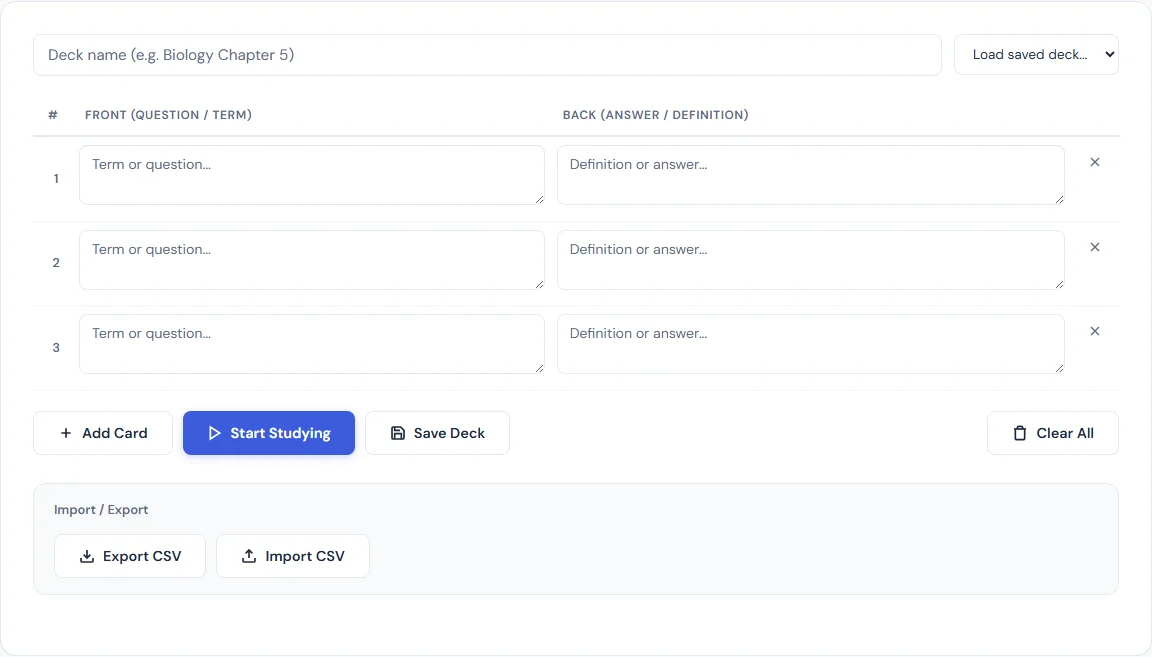
The Forgetting Curve — Why Cramming Fails
In 1885, German psychologist Hermann Ebbinghaus ran a now-famous experiment on himself. He memorized lists of nonsense syllables and measured how quickly he forgot them. What he found was striking: within 20 minutes, he had already lost about 40% of what he learned. After a day, nearly 70% was gone. After a week, he retained almost nothing.
This pattern — rapid initial forgetting that gradually levels off — is called the forgetting curve. It applies to everyone, regardless of intelligence or effort. The information you crammed the night before an exam is already fading by the time you sit down to take it.
Cramming feels productive because it creates a temporary sense of familiarity. You recognize the material, so you assume you know it. But recognition is not the same as recall. Recognizing an answer on a multiple-choice test is easier than producing it from memory on an essay exam. And in real life — at work, in conversations, during presentations — you need recall, not recognition.
Spaced Repetition — How It Works
Spaced repetition is the antidote to the forgetting curve. Instead of reviewing material once and hoping it sticks, you review it at strategically increasing intervals. The first review might happen after one day. The next after three days. Then a week. Then two weeks. Each successful review pushes the next one further into the future.
The reason this works is a phenomenon called the spacing effect. When you revisit material right before you are about to forget it, the act of retrieval strengthens the memory far more than reviewing it while it is still fresh. Your brain essentially says, "I almost lost this — it must be important," and encodes it more deeply.
The Leitner System
One of the simplest implementations of spaced repetition is the Leitner system, developed by German science journalist Sebastian Leitner in the 1970s. It works like this:
- Box 1: New cards. Review every day.
- Box 2: Cards you got right once. Review every 3 days.
- Box 3: Cards you got right twice. Review every week.
- Box 4: Cards you got right three times. Review every 2 weeks.
- Box 5: Mastered cards. Review monthly.
When you get a card wrong, it goes back to Box 1 regardless of where it was. This forces you to spend most of your time on the material you actually struggle with, rather than mindlessly reviewing things you already know.
You do not need physical boxes. A digital flashcard maker lets you create, organize, and review cards from any device. The important thing is the principle: increase the interval after each correct answer, reset after each mistake.
Active Recall — The Other Half
Spaced repetition tells you when to study. Active recall tells you how.
Active recall means testing yourself on the material instead of passively reviewing it. Instead of reading your notes on photosynthesis, you close your notes and try to explain photosynthesis from memory. Instead of highlighting the key dates in a history chapter, you quiz yourself: "What year did the Treaty of Versailles happen? What were its major provisions?"
A landmark 2011 study by Karpicke and Blunt, published in Science, compared four study methods:
- Reading the material once
- Reading the material four times
- Creating concept maps while studying
- Studying once, then practicing recall
The recall group outperformed every other group by a significant margin — including the students who studied the material four times as long. The act of retrieving information from memory is itself the most powerful form of learning.
Why Passive Review Feels Effective (But Is Not)
Re-reading and highlighting create what psychologists call fluency illusions. The material feels familiar, so your brain interprets that familiarity as understanding. But familiarity and understanding are different things. You can be deeply familiar with a concept — you have read about it five times — and still be unable to explain it without your notes in front of you.
Active recall is harder. It is uncomfortable. You will stare at a blank card and feel like you know nothing. That struggle is not a sign that the method is failing — it is the method working. The effort of retrieval is what builds durable memory.
How to Build a Study System That Actually Works
Spaced repetition and active recall are most powerful when combined. Here is a practical system you can set up in about 15 minutes:
Step 1: Make Flashcards as You Learn
Do not wait until the night before the exam to create study materials. As you attend lectures, read textbooks, or watch videos, create flashcards for key concepts, definitions, formulas, and processes. Keep the cards atomic — one idea per card. A card that asks "Explain the entire Krebs cycle" is too broad. A card that asks "What molecule enters the Krebs cycle?" is right.
The SmarterSources Flashcard Maker lets you create decks, tag cards by topic, and review them in randomized order. Everything saves to your browser, so your cards are always ready when you are.
Step 2: Schedule Your Review Sessions
Consistency matters more than duration. Three 25-minute review sessions spread across the week will beat a single 3-hour cram session every time. Use a study schedule builder to block out specific review windows for each subject. Assign each subject a day pattern that follows spaced intervals:
- New material: review the next day
- After first successful review: review in 3 days
- After second: review in 1 week
- After third: review in 2 weeks
The schedule does not have to be rigid. The point is to have a structure that prevents you from ignoring subjects until exam week.
Step 3: Use Focused Work Blocks
The Pomodoro Technique — 25 minutes of focused work followed by a 5-minute break — pairs perfectly with flashcard review. One Pomodoro is enough to review 30–50 cards, and the built-in break prevents the mental fatigue that makes long study sessions unproductive.
Use a Pomodoro timer to keep your sessions structured. After four Pomodoros, take a longer 15–30 minute break. Most students find that 3–4 Pomodoros per day is sustainable for an entire semester, while 8-hour cram sessions are not.
Step 4: Track What You Have Mastered
As you review, pay attention to which cards you consistently get right and which ones keep tripping you up. The cards you always nail can move to a less frequent review schedule. The ones you keep missing need more repetition.
This is where the Leitner system shines. By sorting cards into frequency buckets based on your actual performance, you spend 80% of your time on the 20% of material that actually challenges you. Over time, the "hard" pile shrinks as concepts move into long-term memory.
Common Mistakes to Avoid
Making Cards Too Complex
Each card should test exactly one piece of knowledge. "What are the three branches of the U.S. government?" is fine. "Explain the structure and function of the U.S. federal government including the roles of each branch, the system of checks and balances, and key constitutional amendments" belongs in an essay prompt, not a flashcard.
Only Making Definition Cards
Definitions are the easiest cards to create but the least useful in isolation. Supplement them with application cards ("Given X scenario, which principle applies?"), comparison cards ("How does mitosis differ from meiosis?"), and process cards ("What are the steps of cellular respiration in order?").
Skipping the Struggle
When you flip a card and cannot remember the answer, there is a temptation to immediately look at the back and think, "Oh right, I knew that." You did not know it. Sit with the question for 10–15 seconds before flipping. The struggle to retrieve is where learning happens. If you skip it, you are doing passive review with extra steps.
Studying Without a Schedule
"I will study when I have time" means you will study the night before the exam. Spaced repetition only works if the spacing actually happens. Block time on your calendar, set reminders, and treat study sessions like appointments you cannot cancel.
The Research Is Clear
A 2013 meta-analysis by Dunlosky et al. in Psychological Science in the Public Interest evaluated ten common study techniques and rated them by effectiveness. The results were unambiguous:
- High effectiveness: Practice testing (active recall), distributed practice (spaced repetition)
- Moderate effectiveness: Interleaved practice, elaborative interrogation
- Low effectiveness: Highlighting, re-reading, summarization
The two techniques most students default to — highlighting and re-reading — ranked at the bottom. The two techniques almost nobody uses — active recall and spaced repetition — ranked at the top. This is not a subtle difference. It is a generational gap in study effectiveness that most schools never teach.
Start Today, Not Next Semester
You do not need to overhaul your entire study routine at once. Start with one subject. Create 20 flashcards from your most recent lecture. Review them tomorrow. Review them again in three days. That is it. Within a week, you will notice that you remember more from that one lecture than from the three you re-read your notes for.
The tools are free. The science is settled. The only variable is whether you start.
Frequently Asked Questions
How many flashcards should I make per lecture or chapter?
Aim for 10 to 30 cards per lecture or chapter, depending on the density of the material. Focus on key concepts, definitions, formulas, and processes rather than trying to capture every detail. Quality matters more than quantity — a deck of 20 well-crafted cards will serve you better than 100 vague ones.
Does spaced repetition work for subjects that are not memorization-heavy?
Yes. While spaced repetition is most obviously useful for vocabulary, dates, and formulas, it also works for conceptual subjects like philosophy, literature, and law. The key is writing cards that test understanding rather than rote recall. Instead of "Define utilitarianism," try "How would a utilitarian evaluate a policy that benefits 90% of people but harms 10%?"
How long should each study session be?
Research suggests that 25 to 50 minutes of focused study followed by a short break is more effective than marathon sessions. The Pomodoro Technique (25 minutes on, 5 minutes off) is a popular structure. Most students find that 2 to 4 focused sessions per day is sustainable over a full semester.
Is it too late to start spaced repetition mid-semester?
No. Starting mid-semester gives you several weeks of spaced reviews before finals. Begin with your most recent material (which you remember best) and work backward. Even a few weeks of spaced practice will produce better results than cramming everything the night before.
Can I use spaced repetition for professional certifications and standardized tests?
Absolutely. Spaced repetition is widely used for medical board exams (USMLE), bar exams, language learning, and professional certifications like the CPA and PMP. The principles are identical — create cards for key content, review at increasing intervals, and focus your time on material you consistently miss.
BLIPP built SmarterSources to replace expensive subscriptions with free, private tools. Every tool runs in your browser — no sign-ups, no limits.