The True Cost of Hiring an Employee — What Salary Doesn't Tell You

You post a job at $60,000 per year and get a great candidate. The budget math seems straightforward: $60,000 in salary, maybe a few thousand for benefits, and you are set. Then reality arrives. Social Security contributions, Medicare, unemployment insurance, health coverage, equipment, software licenses, paid time off. By the time every line item is added up, that $60,000 employee is costing you $78,000 or more.
This gap between what you put on the offer letter and what actually leaves your business account catches many first-time employers off guard. Understanding the full cost of an employee is essential for setting prices, forecasting cash flow, and deciding whether to hire full-time, part-time, or contract. This guide breaks down every category of cost so you can budget with confidence.
Want to see your actual cost per employee right now? Enter a salary and toggle benefits.
Calculate Employee Cost Free →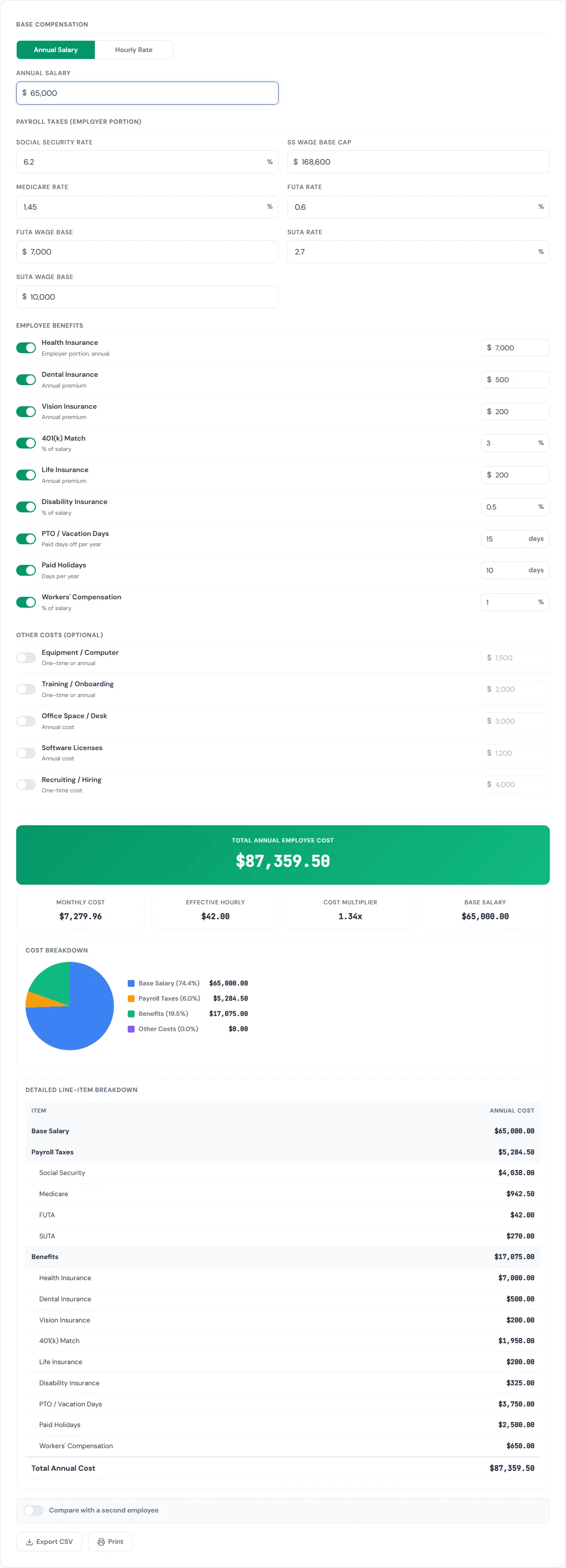
The Cost Multiplier: The Number Every Employer Should Know
The cost multiplier is the simplest way to think about total employee cost. It is the ratio of your total annual spend on an employee divided by their base salary. If an employee earns $60,000 and your total cost is $78,000, the multiplier is 1.3x.
For most small and mid-size businesses, the cost multiplier falls between 1.25x and 1.4x. That means for every dollar of salary, you should budget an additional 25 to 40 cents for taxes, benefits, and overhead. Companies with generous benefit packages (tech startups with premium health plans and 401(k) matches, for example) can see multipliers of 1.5x or higher.
Knowing your multiplier lets you work backward from revenue. If a client engagement brings in $120,000 per year, and you need to hire someone at $80,000 to service it, a 1.35x multiplier means the true cost is $108,000, leaving $12,000 in margin rather than the $40,000 you might have assumed.
Mandatory Payroll Taxes: The Costs You Cannot Avoid
Every W-2 employer in the United States is required to pay the employer portion of several payroll taxes. These are non-negotiable and apply from the first dollar of wages.
Social Security (OASDI): 6.2% of wages up to the annual wage base, which is $168,600 for 2024 and $176,100 for 2025. For an employee earning $60,000, that is $3,720 per year. This is separate from the 6.2% withheld from the employee's paycheck. The employer and employee each pay their half.
Medicare: 1.45% of all wages with no cap. For a $60,000 salary, that is $870 per year. Unlike Social Security, there is no upper limit. High-earning employees trigger an additional 0.9% surtax on their portion, but the employer rate stays at 1.45%.
Federal Unemployment Tax (FUTA): The gross rate is 6.0% on the first $7,000 of each employee's wages. However, employers who pay state unemployment tax on time receive a 5.4% credit, reducing the effective FUTA rate to 0.6%. That works out to just $42 per employee per year, but it is required for every employee.
State Unemployment Tax (SUTA): This varies significantly by state and by your company's experience rating (a history of how many former employees have filed unemployment claims). New employers typically start at a default rate, often around 2.7%. The wage base varies from $7,000 (same as FUTA) to over $50,000 in some states. A state with a $10,000 wage base at 2.7% costs $270 per employee.
Total mandatory payroll taxes for a $60,000 employee: approximately $4,900 to $5,200, or about 8-9% of salary. This is the absolute minimum additional cost every employer pays.
Health Insurance: Usually the Biggest Benefit Expense
Employer-sponsored health insurance is typically the single largest benefit cost, and the one that most directly affects your ability to attract talent.
According to the Kaiser Family Foundation's 2024 employer health benefits survey, the average annual premium for employer-sponsored health insurance was:
- Single coverage: $8,951, with employers paying an average of $7,151 (80%)
- Family coverage: $25,572, with employers paying an average of $18,401 (72%)
These are averages. Actual costs vary widely based on plan type (HMO, PPO, HDHP), geographic region, employee demographics, and the employer's contribution strategy. A small business in a high-cost metro area may pay significantly more. Some employers cover 100% of employee-only premiums. Others split costs 70/30 or 60/40.
The decision of whether and how much to contribute toward health insurance is one of the biggest levers in your total employee cost. Offering no health coverage saves money but limits your candidate pool. Offering a generous plan costs more but reduces turnover, and turnover is expensive on its own.
Retirement Benefits: 401(k) Matching
If you offer a 401(k) with an employer match, budget for the match as a direct cost. Common structures include:
- Dollar-for-dollar match up to 3% of salary: costs $1,800/year on a $60,000 salary if the employee contributes at least 3%
- 50 cents on the dollar up to 6% of salary: costs up to $1,800/year (same ceiling, different structure)
- Dollar-for-dollar up to 6%: costs up to $3,600/year, generous but effective for retention
Not every employee will contribute enough to earn the full match, so your actual cost is typically lower than the maximum. However, for budgeting purposes, assume most employees will participate. The actual participation rate for companies with auto-enrollment is above 90%.
Beyond the match itself, there are plan administration fees. Small businesses using off-the-shelf 401(k) platforms typically pay $50 to $150 per participant per year in administrative and record-keeping fees.
Paid Time Off: The Cost of Days Not Worked
Paid time off is a real cost that is easy to overlook because no check is written. The employee is paid their normal salary, but your business gets no productive work in return for those days.
A typical PTO package might include:
- Vacation: 10-15 days (2-3 weeks)
- Sick days: 5-10 days
- Paid holidays: 8-10 days (federal holidays plus company-specific days)
For an employee earning $60,000 with 25 total PTO days (including holidays), the daily rate is about $231 ($60,000 / 260 working days). That is $5,775 in wages paid for days not worked. You could frame this as a hidden 9.6% cost on top of productive compensation.
This does not mean you should not offer PTO. Research consistently shows that adequate time off reduces burnout and turnover, which are far more expensive than the PTO itself. But it should be in your budget model.
Other Insurance: Workers' Comp, Disability, Life
Workers' compensation insurance is required in nearly every state. Rates vary dramatically by industry and job classification. An office worker might cost $0.20 to $0.50 per $100 of payroll, while a construction worker might cost $5 to $15 per $100. For a $60,000 office employee, expect $120 to $300 per year.
Disability insurance (short-term and long-term) is offered by about 40% of private employers. Employer-paid premiums typically run 1-3% of salary, or $600 to $1,800 per year.
Group life insurance is a common low-cost benefit. A basic policy (1x salary) might cost the employer $100 to $300 per year per employee.
Equipment, Software, and Workspace
Every employee needs tools to do their job. The cost varies significantly by role, but here are common line items:
- Computer and peripherals: $1,000-$3,000 (amortized over 3-4 years: $250-$1,000/year)
- Software licenses: $500-$3,000/year (Microsoft 365, Slack, project management tools, industry-specific software)
- Office space: For in-office employees, the cost per desk ranges from $3,000/year in low-cost areas to $15,000+ in major metros. Even coworking memberships run $200-$500/month.
- Phone and internet: $50-$150/month for company phone plans or stipends
Remote employees are not free to equip either. Many companies provide a home office stipend ($500-$1,500 one-time), pay for internet upgrades, and ship equipment.
The Costs Everyone Forgets: Recruiting and Onboarding
Hiring itself has a cost. The Society for Human Resource Management (SHRM) estimates the average cost-per-hire at approximately $4,700. For specialized roles, it can be significantly higher. This includes:
- Job posting fees: $200-$500 per platform (Indeed, LinkedIn, industry boards)
- Recruiter time: Hours spent screening resumes, conducting interviews, checking references
- Background checks: $30-$100 per candidate
- Recruiter fees (if using an agency): 15-25% of first-year salary for permanent placements
Onboarding and training is another hidden cost. A new employee typically operates at reduced productivity for 1-3 months. During this time, existing team members spend hours training, reviewing work, and answering questions. Some estimates put the total onboarding cost at 50-100% of the position's monthly salary.
These are not recurring annual costs, but if you have turnover, they repeat with every replacement hire. This is one reason why retention is so important. Every employee who stays saves you the full cycle of recruiting, hiring, and ramping up a replacement.
Putting It All Together: A $60,000 Employee Example
Here is a realistic cost breakdown for a $60,000 salaried office employee with a moderate benefits package:
- Base salary: $60,000
- Social Security (6.2%): $3,720
- Medicare (1.45%): $870
- FUTA (0.6% on $7,000): $42
- SUTA (2.7% on $10,000): $270
- Health insurance (employer share): $7,150
- 401(k) match (3%): $1,800
- Dental + vision: $600
- Life insurance: $200
- Workers' comp: $200
- Equipment/software (annualized): $1,500
- Total: $76,352
- Cost multiplier: 1.27x
Add in PTO cost (paid but not productive), office space, and onboarding, and the effective multiplier climbs to 1.35x or higher. For budgeting purposes, 1.3x is a reasonable starting point for modest benefits, and 1.4x for competitive benefits packages.
Rather than estimating by hand, you can enter exact figures into the Employee Cost Calculator to see a detailed breakdown with pie chart and CSV export.
Full-Time Employee vs. Contractor: When the Math Changes
One reason this cost analysis matters is the decision between hiring a W-2 employee and engaging a 1099 independent contractor.
With a contractor, you pay no payroll taxes, no benefits, no equipment costs, and no PTO. The contractor handles their own self-employment tax (15.3% combined Social Security and Medicare), their own health insurance, and their own retirement savings. This is why contractors typically charge higher hourly rates than equivalent employees.
The break-even math: if an employee costs $60,000 in salary plus $18,000 in taxes and benefits ($78,000 total), a contractor charging $78,000 costs the same. But a contractor charging $70,000 saves you money and eliminates the administrative burden of employment. A contractor charging $90,000 costs more, but may be worth it for specialized, project-based work where you do not need ongoing headcount.
Important: The IRS has strict rules about who qualifies as an independent contractor. Misclassifying an employee as a contractor to avoid payroll taxes and benefits can result in significant penalties, back taxes, and interest. The distinction is based on behavioral control, financial control, and the type of relationship, not simply what you call the arrangement.
Three Steps to Budget for Your Next Hire
1. Start with the salary range. Research market rates for the role using Glassdoor, LinkedIn Salary, or Bureau of Labor Statistics data. The salary needs to be competitive enough to attract qualified candidates.
2. Apply your multiplier. If you know your benefits package, calculate the exact multiplier using the Employee Cost Calculator. If you are still planning, use 1.3x as a conservative estimate or 1.4x if you plan to offer health insurance and a retirement match.
3. Add one-time costs. Budget for recruiting ($3,000-$5,000), equipment ($1,000-$3,000), and a productivity ramp-up period (1-3 months of reduced output). These do not recur annually, but they affect your first-year cash flow.
The Employee Cost Calculator lets you toggle individual benefits on and off, adjust tax rates for your state, add custom cost line items, and compare two employees side by side. Export the breakdown as a CSV to share with your accountant, partner, or board.
Frequently Asked Questions
How much does an employee really cost beyond their salary?
On average, employers spend an additional 25-40% on top of base salary for payroll taxes, benefits, and overhead. A $60,000 employee typically costs $75,000 to $84,000 total. The exact amount depends on your benefits package, state unemployment rates, and overhead costs.
What is a good cost multiplier to use for budgeting?
Use 1.25x if you offer minimal benefits (payroll taxes only), 1.3x for moderate benefits (health insurance, basic PTO), and 1.4x or higher for competitive packages (premium health plan, 401(k) match, generous PTO). When in doubt, 1.35x is a reasonable middle estimate.
Are payroll taxes the same in every state?
Federal payroll taxes (Social Security, Medicare, FUTA) are the same nationwide. State Unemployment Tax (SUTA) varies significantly. Both the tax rate and the wage base differ by state and by your company's claims history. Some states also have additional employer taxes such as paid family leave or disability funds.
Should I hire an employee or a contractor?
It depends on the nature of the work, the duration, and the level of control you need. Contractors cost less in overhead but charge higher rates. Employees cost more in benefits and taxes but give you more control over how, when, and where the work is done. The IRS has specific criteria for classification, and misclassifying a worker can result in penalties.
How do I reduce my per-employee cost?
Shop health insurance plans annually, consider high-deductible health plans with HSA contributions (often cheaper for both employer and employee), use a PEO or payroll provider that negotiates group rates, and invest in retention to avoid repeated recruiting and onboarding costs. Reducing turnover is often the single most effective way to lower per-employee costs over time.
BLIPP built SmarterSources to replace expensive subscriptions with free, private tools. Every tool runs in your browser — no sign-ups, no limits.