Unit Conversions Cheat Sheet — Length, Weight, Temperature, Data

Whether you are cooking a recipe from another country, shipping a package internationally, traveling abroad, or working through a physics assignment, unit conversions come up constantly. The math itself is straightforward, but remembering the right multiplier for every combination of units is not something most people can do off the top of their head. That is where a cheat sheet earns its keep.
This guide covers every common conversion across length, weight, volume, temperature, and digital storage. Each section includes a reference table with precise multipliers, key formulas worth memorizing, and context for when each conversion matters most. Bookmark this page and stop Googling the same conversions over and over.
Need a quick conversion? Type a value and get instant results.
Open the Unit Converter →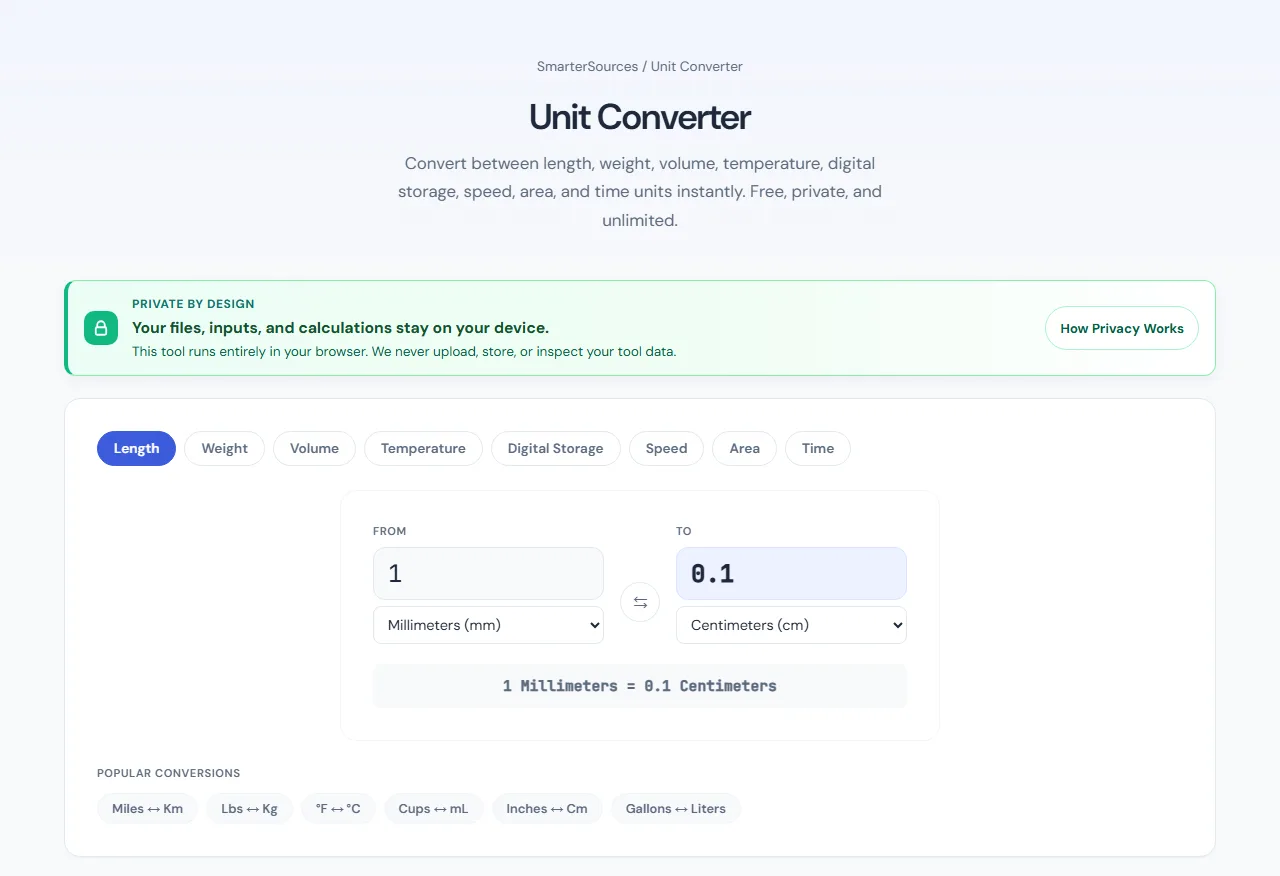
Length Conversions
Length is the most frequently converted measurement category. The metric system uses millimeters, centimeters, meters, and kilometers while the imperial system uses inches, feet, yards, and miles. The core anchor point to remember is that 1 inch equals exactly 2.54 centimeters. Every other length conversion between the two systems derives from that single relationship.
| From | To | Multiply by |
|---|---|---|
| Inches | Centimeters | 2.54 |
| Centimeters | Inches | 0.3937 |
| Feet | Meters | 0.3048 |
| Meters | Feet | 3.281 |
| Yards | Meters | 0.9144 |
| Meters | Yards | 1.094 |
| Miles | Kilometers | 1.609 |
| Kilometers | Miles | 0.6214 |
Key formulas: 1 inch = 2.54 cm. 1 foot = 0.3048 m. 1 mile = 1.609 km. 1 meter = 3.281 feet. A quick mental shortcut for miles to kilometers: multiply by 1.6. For kilometers to miles, multiply by 0.6. These approximations are accurate enough for everyday estimates like reading road signs in Europe or judging race distances.
Weight Conversions
Weight conversions are essential for cooking, fitness tracking, shipping, and international commerce. The metric system uses grams and kilograms while the imperial system uses ounces, pounds, stones, and tons. The key anchor: 1 pound equals 0.4536 kilograms, or roughly 0.45 kg for quick mental math.
| From | To | Multiply by |
|---|---|---|
| Ounces | Grams | 28.35 |
| Grams | Ounces | 0.03527 |
| Pounds | Kilograms | 0.4536 |
| Kilograms | Pounds | 2.205 |
| Stones | Kilograms | 6.35 |
| Kilograms | Stones | 0.1575 |
| US Tons (short) | Metric Tonnes | 0.9072 |
| Metric Tonnes | US Tons (short) | 1.102 |
Key formulas: 1 lb = 0.4536 kg. 1 kg = 2.205 lb. 1 stone = 14 pounds = 6.35 kg. 1 US ton (short ton) = 2,000 pounds = 0.9072 metric tonnes. Note that a US ton (2,000 lb) is different from a UK ton (2,240 lb, also called a long ton) and a metric tonne (1,000 kg = 2,204.6 lb). When someone says "ton" without qualification, context matters.
Volume Conversions
Volume conversions are most commonly needed in the kitchen. Recipes from different countries use different measurement systems, and even within the US system there is an awkward mix of cups, tablespoons, fluid ounces, and quarts. The metric system keeps it simpler with milliliters and liters.
| From | To | Multiply by |
|---|---|---|
| Teaspoons (tsp) | Milliliters | 4.929 |
| Tablespoons (tbsp) | Milliliters | 14.79 |
| Fluid Ounces (fl oz) | Milliliters | 29.57 |
| Cups (US) | Milliliters | 236.6 |
| Pints (US) | Liters | 0.4732 |
| Quarts (US) | Liters | 0.9464 |
| Gallons (US) | Liters | 3.785 |
| Liters | Gallons (US) | 0.2642 |
Kitchen-friendly numbers: 1 cup = 237 ml (often rounded to 240 ml). 1 tablespoon = 14.79 ml (round to 15 ml). 1 gallon = 3.785 liters. 1 liter = 4.227 cups. For baking, where precision matters, use a kitchen scale and measure by weight rather than volume. A cup of flour can vary by 30% or more depending on how tightly it is packed.
Temperature Conversions
Temperature is one of the trickiest conversions because it is not a simple multiplication. Fahrenheit and Celsius use different zero points and different scale increments, so you need a formula rather than a single conversion factor. Kelvin, used in science, simply offsets Celsius by 273.15 degrees.
Fahrenheit to Celsius: C = (F - 32) × 5/9
Celsius to Fahrenheit: F = C × 9/5 + 32
Celsius to Kelvin: K = C + 273.15
| Description | °C | °F |
|---|---|---|
| Water freezes | 0 | 32 |
| Cool room | 15 | 59 |
| Comfortable room | 20 | 68 |
| Warm day | 30 | 86 |
| Body temperature | 37 | 98.6 |
| Hot summer day | 40 | 104 |
| Water boils | 100 | 212 |
| Oven (moderate) | 180 | 356 |
Quick estimation trick: To roughly convert Celsius to Fahrenheit in your head, double the Celsius value and add 30. For example, 25°C becomes (25 × 2) + 30 = 80°F. The actual answer is 77°F, so the estimate is close enough for deciding what to wear. This shortcut works best in the 0–40°C range that covers most weather temperatures.
Digital Storage Conversions
Digital storage uses a hierarchy of units based on powers of two (binary) or powers of ten (decimal). Traditionally, 1 kilobyte meant 1,024 bytes because computers operate in binary. However, hard drive manufacturers and the International Electrotechnical Commission (IEC) adopted a base-10 definition where 1 kilobyte = 1,000 bytes. This discrepancy is why a "500 GB" hard drive shows up as roughly 465 GB in your operating system.
| Unit | Binary (traditional) | Decimal (SI) |
|---|---|---|
| 1 Byte | 8 bits | 8 bits |
| 1 Kilobyte (KB) | 1,024 bytes | 1,000 bytes |
| 1 Megabyte (MB) | 1,048,576 bytes | 1,000,000 bytes |
| 1 Gigabyte (GB) | 1,024 MB | 1,000 MB |
| 1 Terabyte (TB) | 1,024 GB | 1,000 GB |
| 1 Petabyte (PB) | 1,024 TB | 1,000 TB |
The IEC introduced unambiguous binary prefixes (KiB, MiB, GiB) to resolve the confusion, where 1 KiB = 1,024 bytes and 1 kB = 1,000 bytes. In practice, most software and operating systems still display "GB" when they mean GiB (binary). When the distinction matters, such as calculating storage requirements or network transfer costs, pay attention to which convention is being used. The difference compounds at larger scales: a "1 TB" drive labeled using decimal holds about 931 GiB in binary terms.
Metric vs Imperial: A Quick Primer
The metric system (formally the International System of Units, or SI) is used by virtually every country in the world. It is based on powers of ten, which makes conversions within the system trivial: 1 kilometer = 1,000 meters, 1 kilogram = 1,000 grams, 1 liter = 1,000 milliliters. Prefixes like kilo-, centi-, and milli- apply consistently across all measurement types.
The imperial system, sometimes called US customary units, is used primarily in the United States for everyday measurements. Myanmar and Liberia are often cited as the only other countries that have not officially adopted the metric system, though even they use metric in many contexts. The UK occupies a middle ground, using metric for most official purposes but retaining miles for road signs, stones for body weight, and pints for beer.
The imperial system evolved organically over centuries from Roman, Anglo-Saxon, and medieval English measurements. There is no consistent base. There are 12 inches in a foot, 3 feet in a yard, 1,760 yards in a mile, 16 ounces in a pound, 14 pounds in a stone. These relationships have to be memorized individually because there is no mathematical pattern connecting them. The metric system was deliberately designed during the French Revolution to replace exactly this kind of inconsistency.
Kitchen Measurement Quick Reference
Kitchen measurements in the US system nest inside each other in ways that are easy to forget. This compact reference covers the relationships between common cooking measurements.
| Measurement | Equivalent | Metric (approx.) |
|---|---|---|
| 1 pinch | 1/16 teaspoon | 0.3 ml |
| 1 dash | 1/8 teaspoon | 0.6 ml |
| 1 teaspoon (tsp) | 1/3 tablespoon | 4.9 ml |
| 1 tablespoon (tbsp) | 3 teaspoons | 14.8 ml |
| 1 fluid ounce (fl oz) | 2 tablespoons | 29.6 ml |
| 1 cup | 8 fluid ounces | 237 ml |
| 1 pint | 2 cups | 473 ml |
| 1 quart | 4 cups / 2 pints | 946 ml |
| 1 gallon | 4 quarts / 16 cups | 3,785 ml |
For international recipes, the metric cup is 250 ml (used in Australia, New Zealand, and some other countries), while the US cup is 237 ml and the Japanese cup is 200 ml. A UK recipe that calls for a "cup" usually means an imperial cup of 284 ml, though many modern UK recipes have switched to metric weights. When in doubt, weigh your ingredients on a kitchen scale for the most reliable results.
Frequently Asked Questions
Why are there different measurement systems?
Measurement systems evolved independently across cultures over thousands of years. The imperial system grew out of English units rooted in Roman and medieval standards. The metric system was created during the French Revolution in the 1790s as a rational, base-10 alternative. Most countries adopted metric during the 19th and 20th centuries through international treaties. The US attempted metrication in the 1970s with the Metric Conversion Act, but the effort was voluntary and ultimately stalled because there was no mandatory deadline or penalty for non-compliance.
Is a UK pint the same as a US pint?
No. A US pint is 473 ml (16 US fluid ounces) while a UK pint is 568 ml (20 imperial fluid ounces). The UK pint is about 20% larger. This is because the US fluid ounce and the imperial fluid ounce are slightly different sizes (29.57 ml vs 28.41 ml), and the UK pint contains 20 of its ounces rather than 16. If you order a pint of beer in London, you are getting noticeably more than you would in New York.
What is the difference between a fluid ounce and a dry ounce?
A fluid ounce measures volume (how much space something takes up) while a dry ounce measures weight (how heavy something is). One fluid ounce of water happens to weigh very close to one dry ounce, which is where the naming overlap comes from. But for other substances, the relationship breaks down. One fluid ounce of honey weighs about 1.5 dry ounces because honey is denser than water. One fluid ounce of flour weighs only about 0.5 dry ounces because flour is lighter by volume. Always check whether a recipe means fluid ounces (volume) or ounces (weight).
Are KB and kB the same thing?
Technically, no. In the IEC standard, KB (uppercase K) typically refers to a kilobyte of 1,024 bytes (binary), while kB (lowercase k) refers to 1,000 bytes (decimal, using the SI prefix "kilo"). In practice, the distinction is widely ignored and most people use KB to mean either one depending on context. Operating systems use the binary definition (1 KB = 1,024 bytes) while storage manufacturers and network speeds use the decimal definition (1 kB = 1,000 bytes). The IEC introduced KiB (kibibyte) for 1,024 bytes to resolve the ambiguity, but adoption has been slow outside of Linux distributions and technical specifications.
BLIPP built SmarterSources to replace expensive subscriptions with free, private tools. Every tool runs in your browser — no sign-ups, no limits.