What Your GPA Actually Means — How It’s Calculated, Why It Matters, and When It Doesn’t

Few numbers cause as much anxiety as your GPA. It shows up on transcripts, scholarship applications, and job postings. It gets discussed at family dinners. And despite how much weight people give it, most students cannot actually explain how it is calculated — or what a "good" GPA even means.
This guide breaks down exactly how GPA works, clears up the weighted vs. unweighted confusion, explains what colleges and employers actually care about, and shows you how to figure out what grade you need to hit your target.
Want to calculate your GPA right now? Enter your courses and grades — it takes about 30 seconds.
Calculate Your GPA →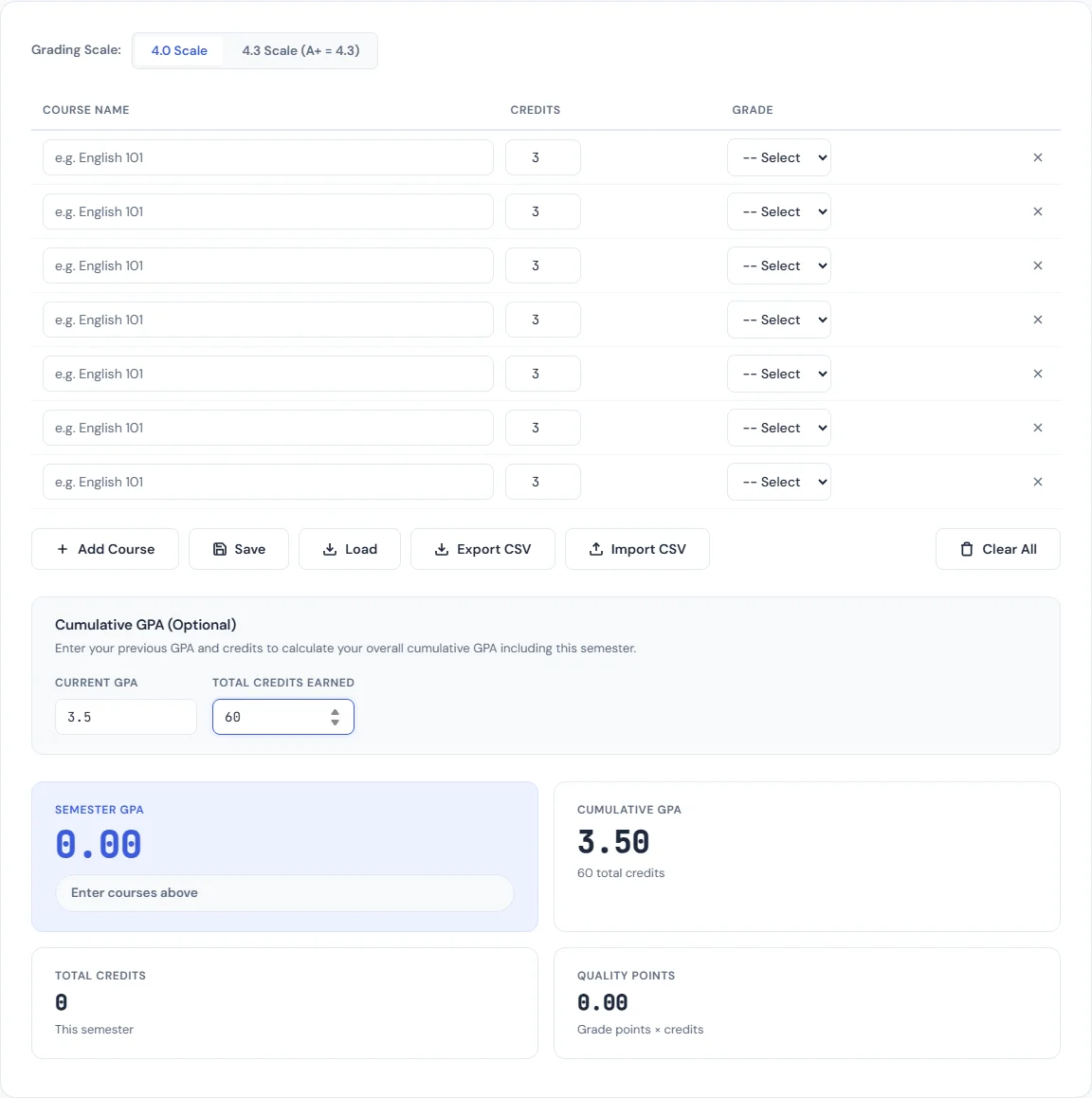
How GPA Is Actually Calculated
GPA stands for Grade Point Average. The formula is straightforward: multiply each course’s grade points by its credit hours, add them up, and divide by total credit hours. Here is a simple example:
- English (3 credits) — A (4.0) → 3 × 4.0 = 12.0
- Biology (4 credits) — B+ (3.3) → 4 × 3.3 = 13.2
- History (3 credits) — A- (3.7) → 3 × 3.7 = 11.1
- Math (4 credits) — B (3.0) → 4 × 3.0 = 12.0
Total quality points: 48.3. Total credits: 14. GPA: 48.3 ÷ 14 = 3.45.
Notice that credit hours matter. A 4-credit course has more impact on your GPA than a 3-credit course. An A in a 1-credit elective will barely move the needle, while a C in a 4-credit core course will drag it down significantly.
The Standard Grade Point Scale
- A = 4.0 | A- = 3.7
- B+ = 3.3 | B = 3.0 | B- = 2.7
- C+ = 2.3 | C = 2.0 | C- = 1.7
- D+ = 1.3 | D = 1.0 | D- = 0.7
- F = 0.0
Some schools use a simpler scale without plus/minus grades. Others cap the scale at 4.0 with no A+ distinction. Your school’s registrar page will have the exact scale they use — it is worth checking, because the difference between "A- = 3.7" and "A- = 3.67" can matter at the margins.
Weighted vs. Unweighted GPA
This is the single biggest source of GPA confusion, especially in high school.
Unweighted GPA uses the standard 4.0 scale. An A is a 4.0 whether you earned it in a regular class or an AP class. The maximum unweighted GPA is 4.0.
Weighted GPA gives extra points for advanced courses. Typically, honors courses add 0.5 points and AP/IB courses add 1.0 point to the grade value. An A in an AP class is worth 5.0 instead of 4.0. This means weighted GPAs can exceed 4.0 — a student with mostly AP courses and strong grades might have a 4.5 or even 4.8.
Colleges know the difference. When an admissions officer sees a 4.3 GPA, they understand it is weighted and factor in course rigor accordingly. A 3.8 unweighted GPA with a challenging course load is generally more impressive than a 4.0 unweighted GPA with all standard-level classes.
Cumulative vs. Semester GPA
Your semester GPA reflects only the courses from that term. Your cumulative GPA includes every course you have taken since you started. Cumulative GPA is what appears on your transcript and what colleges, graduate schools, and employers look at.
This has an important mathematical consequence: the more credits you have completed, the harder it is to move your cumulative GPA. A freshman with 15 credits can raise their GPA significantly in one semester. A senior with 100+ credits will barely budge it. If you had a rough freshman year, the best strategy is to take more credits with strong grades — not just to maintain a high average, but to dilute the early damage with volume.
What’s a "Good" GPA?
There is no universal answer because context matters enormously:
- 3.5–4.0: Generally considered excellent. Opens doors to honors programs, competitive scholarships, and top graduate schools.
- 3.0–3.49: Solid. Meets the minimum for most graduate programs and many employer GPA cutoffs. A 3.2 in engineering carries more weight than a 3.8 in an easier major — and admissions committees know it.
- 2.5–2.99: Average to below average. May limit scholarship eligibility and some job applications, but is not disqualifying for most career paths.
- Below 2.0: Typically triggers academic probation. Most programs require at least a 2.0 to graduate.
The most important thing to understand is that GPA is relative. A 3.3 in chemical engineering from a rigorous program is not the same as a 3.3 in general studies. Employers and graduate programs evaluate GPA in context — your major, your institution, and your trend over time all factor in.
How Colleges and Employers Actually Use Your GPA
College Admissions
Most colleges practice holistic review, meaning GPA is one factor among many. They also consider course rigor (AP/IB/honors), standardized test scores, extracurriculars, essays, and recommendations. A student with a 3.6 GPA who took the hardest available courses is generally a stronger applicant than a student with a 4.0 who avoided every challenge.
That said, GPA does serve as a screening tool. Many selective schools have a de facto GPA floor below which applications are rarely considered. Knowing your target school’s admitted student profile helps you set realistic goals.
Graduate School
Graduate programs tend to weigh GPA more heavily than undergraduate admissions, particularly in your major courses. A 3.0 overall with a 3.7 in your major tells a different story than a 3.0 across the board. Many programs publish minimum GPA requirements, but admitted students typically have GPAs well above the stated minimum.
Employers
Some employers — particularly in consulting, finance, and large tech companies — use GPA cutoffs (often 3.0 or 3.5) to screen entry-level applicants. After your first job, GPA becomes largely irrelevant. No one asks about your college GPA when you have five years of work experience.
For most career paths, GPA matters for about 2–3 years after graduation. Skills, experience, and professional reputation take over from there.
The "What Grade Do I Need?" Panic
Every student has this moment: it is week 12, you know your current average, and you need to figure out what score you need on the final to keep your grade. This is where a final grade calculator saves you from bad algebra at 2 AM.
The formula is simple but easy to mess up by hand:
Required final grade = (Target grade − Current grade × (1 − Final weight)) ÷ Final weight
For example, if you currently have an 82% in a course where the final is worth 30%, and you need a B (83%) to maintain your GPA target:
Required final = (83 − 82 × 0.70) ÷ 0.30 = (83 − 57.4) ÷ 0.30 = 85.3%
The Final Grade Needed Calculator does this math instantly. Plug in your current grade, the final exam weight, and your target — and it tells you exactly what you need.
How to Raise Your GPA — The Math
If your GPA is lower than you want, the path forward depends on where you are in your academic career:
Early in College (Under 30 Credits)
You are in the best position to recover. Every strong semester has an outsized impact because your total credit hours are low. A student with a 2.5 GPA after 15 credits who earns a 3.8 over the next 15 credits will have a cumulative GPA of 3.15. That is a massive jump.
Mid-College (30–60 Credits)
Recovery is still very achievable, but it requires sustained effort. Use a GPA calculator to model different scenarios: "If I get a 3.5 for the next two semesters, where does my cumulative land?" This turns an abstract goal into a concrete target for each course.
Late in College (60+ Credits)
The math works against you here. With 90 credits at a 2.8, even a perfect 4.0 semester of 15 credits only raises your cumulative to 2.97. The strategy shifts from "raise the number" to "strengthen the narrative." Take challenging courses in your major, earn strong grades in them, and let your upward trend tell the story.
Strategic Course Selection
Not all credits are equal for GPA repair. A 4-credit course with an A has twice the impact of a 2-credit course with an A. If you have room for electives, choosing courses where you are confident you can excel — and that carry higher credit loads — is a legitimate strategy. This is not gaming the system; it is understanding how weighted averages work.
Use the Grade Calculator to check your standing in each course throughout the semester. Knowing where you are early gives you time to adjust before it is too late.
When GPA Doesn’t Matter
It is worth being honest: GPA is one metric, and it has real limitations.
- It does not measure creativity, leadership, or problem-solving — the skills most employers actually value.
- It punishes early mistakes disproportionately. A rough freshman year follows you for the next three years, even if you became a straight-A student by junior year.
- It does not account for difficulty. A 3.0 in a notoriously hard program can represent more learning than a 4.0 in an easy one.
- After your first job, nobody cares. Your work experience, portfolio, and professional network matter infinitely more.
GPA is a tool for getting through gates — scholarships, admissions, first-job screening. Once you are through those gates, what you do matters far more than the number on your transcript.
Know Your Numbers
Whether your GPA is where you want it or not, understanding how it works gives you control. Calculate where you stand, figure out what you need, and make informed decisions about how to spend your effort. The math is not complicated — but ignoring it until it is too late is expensive.
Frequently Asked Questions
Do colleges look at weighted or unweighted GPA?
Most colleges recalculate GPA using their own scale, but they consider both. Weighted GPA shows course rigor (AP, IB, honors), while unweighted GPA provides a standardized comparison. A high unweighted GPA with a challenging course load is generally the strongest combination.
Can I raise my GPA significantly in one semester?
It depends on how many credits you have completed. Early in college (under 30 credits), one strong semester can raise your GPA by 0.3 to 0.5 points. Later in college, the impact shrinks because your cumulative credit hours dilute each new semester. Use a GPA calculator to model your specific scenario.
Does retaking a course replace the old grade in my GPA?
Policies vary by school. Some institutions replace the old grade entirely (grade replacement or forgiveness). Others average the two attempts. Some count both grades but only award credit once. Check your registrar's academic policies to understand your school's specific rule before retaking a course.
What GPA do I need for graduate school?
Most graduate programs require a minimum of 3.0, but competitive programs expect significantly higher. Medical schools average around 3.7, law schools vary widely by ranking, and MBA programs weigh GPA alongside work experience and test scores. Research your target programs for their admitted student profiles rather than relying on stated minimums.
How long does my GPA matter after graduation?
For most careers, GPA is relevant for 2 to 3 years after graduation. Some industries (finance, consulting, large tech) use GPA cutoffs for entry-level hiring. After your first or second job, employers care about work experience, skills, and references rather than your college transcript.
BLIPP built SmarterSources to replace expensive subscriptions with free, private tools. Every tool runs in your browser — no sign-ups, no limits.