How to Calculate Your BMI and What It Actually Means

You step on a scale, note the number, and wonder: does this number mean anything? On its own, weight does not say much. A 200-pound person who is 5'4" and a 200-pound person who is 6'3" have very different frames. Body Mass Index (BMI) exists to account for that difference. It combines weight and height into a single number that provides a rough estimate of where someone falls across a range of body size categories.
BMI is the most commonly referenced screening metric in general medicine. Doctors reference it. The World Health Organization publishes guidelines around it. But it is also widely criticized, and for good reasons we will cover in detail below. Understanding both what BMI measures and what it does not is the key to using it responsibly.
Worth saying up front: BMI is not a measure of your health, your fitness, or your worth. It is a single data point. This guide explains how it works, where it is useful, and where it falls short so you can decide how (or whether) it fits into your own picture of wellness.
Want to skip the math and see your results instantly?
Calculate Your BMI Free →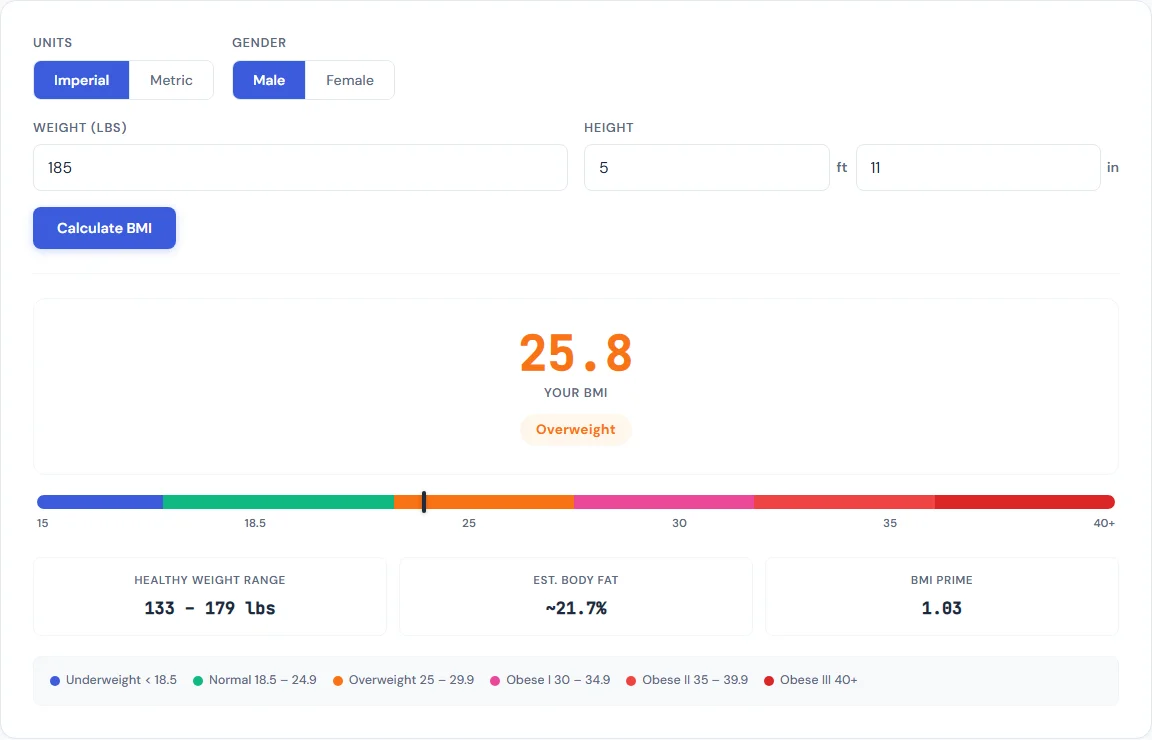
What Is BMI?
BMI stands for Body Mass Index. It is a ratio of your weight to the square of your height. The concept was developed in the 1830s by Belgian mathematician Adolphe Quetelet as a statistical tool to study body size trends across populations. It was never intended as a diagnostic tool for individuals, but over time it became the default screening metric because it is simple, fast, and requires nothing more than a scale and a tape measure.
The result is a single number, typically between 15 and 40 for most adults. At a population level, higher BMI values tend to correlate with higher body fat percentages. But as we will see, that correlation breaks down in many individual cases.
The BMI Formula
There are two versions of the formula depending on whether you use metric or imperial units.
Metric: BMI = weight (kg) ÷ height (m)²
If you weigh 75 kg and stand 1.78 m tall: 75 ÷ (1.78 × 1.78) = 75 ÷ 3.168 = 23.7
Imperial: BMI = (weight (lbs) × 703) ÷ height (inches)²
If you weigh 165 lbs and stand 5'10" (70 inches): (165 × 703) ÷ (70 × 70) = 115,995 ÷ 4,900 = 23.7
The 703 multiplier in the imperial formula is a conversion factor that accounts for the difference between pounds/inches and kilograms/meters. Both formulas produce the same result.
BMI Categories Explained
The World Health Organization defines six BMI categories for adults over 20 years old. These are statistical groupings based on large population studies, not personal judgments. Where you fall in these ranges does not define your health on its own.
- Underweight: Below 18.5. This range may be associated with nutritional gaps or underlying health conditions, though many people naturally fall here and are perfectly healthy.
- Normal weight: 18.5 to 24.9. The range that population-level research associates with the lowest statistical health risk.
- Overweight: 25.0 to 29.9. Statistically associated with a moderate increase in certain health risks, though individual outcomes vary widely. Many active, healthy people fall in this range.
- Obese Class I: 30.0 to 34.9. Research associates this range with elevated statistical risk for conditions like metabolic syndrome and sleep apnea.
- Obese Class II: 35.0 to 39.9. A higher statistical risk bracket. Healthcare providers may recommend additional screening at this level.
- Obese Class III: 40.0 and above. The highest risk bracket in the WHO classification. Also called Class III obesity in clinical settings.
These thresholds come from epidemiological data, meaning large-scale studies that tracked health outcomes across populations over time. They are statistical guidelines, not individual diagnoses. A BMI of 26 does not automatically mean someone is unhealthy, just as a BMI of 22 does not guarantee that they are. Your lifestyle, activity level, genetics, and overall wellbeing matter far more than any single number.
What BMI Does Not Tell You
BMI has significant limitations. Understanding them is just as important as knowing the number itself.
It cannot distinguish muscle from fat. This is the most common and valid criticism. Muscle is denser than fat, so a muscular person will weigh more at the same height than someone with less muscle mass. A professional athlete with 10% body fat might have a BMI of 28, placing them in the "overweight" category despite being in excellent physical condition. If you strength train or have an athletic build, BMI will likely overestimate your body fat.
It ignores where fat is stored. Visceral fat (stored deep in the abdomen around organs) carries different health implications than subcutaneous fat (stored under the skin). Two people with identical BMIs can have very different health profiles depending on their fat distribution. Waist circumference and waist-to-hip ratio are better indicators of visceral fat than BMI alone.
It does not account for age. Body composition shifts naturally over time. Adults tend to gradually lose muscle mass and gain fat as they age, even if their weight stays the same. A 65-year-old and a 25-year-old with the same BMI likely have different body compositions.
It does not account for sex differences. Women naturally carry a higher percentage of body fat than men at the same BMI. The formula does not adjust for this, which is why some calculators (including the SmarterSources BMI Calculator) include a separate body fat estimate based on sex.
It does not account for ethnicity. Research shows that health risks associated with specific BMI values vary across ethnic groups. For example, people of South Asian descent tend to experience metabolic complications at lower BMI thresholds than people of European descent. The WHO has acknowledged this, and some countries use adjusted cutoffs.
BMI Prime: A Simpler Way to Read Your Number
BMI Prime is your BMI divided by 25 (the upper boundary of the "normal" range). It gives you a quick ratio:
- BMI Prime below 1.0 = below the normal/overweight boundary
- BMI Prime of exactly 1.0 = right at the boundary (BMI of 25)
- BMI Prime above 1.0 = above the boundary
A BMI Prime of 0.95 means you are 5% below the boundary. A BMI Prime of 1.12 means you are 12% above it. Some people find this ratio more intuitive than the raw number. The SmarterSources BMI Calculator displays BMI Prime alongside your standard BMI result.
Putting Your BMI in Context
BMI is a starting point, not a conclusion. A single number cannot capture the full picture of anyone's health. Once you have your BMI, here are some ways to add context.
Understand your calorie needs. Regardless of your BMI, knowing your daily energy needs is useful information. A calorie calculator can estimate your BMR (Basal Metabolic Rate) and TDEE (Total Daily Energy Expenditure) based on your activity level. This is helpful whether your goal is maintenance, gradual change, or simply understanding how your body uses energy.
Look at the bigger picture. If you are curious about your body composition beyond BMI, consider additional measurements. Waist circumference (above 40 inches for men or 35 inches for women is a commonly cited reference point), body fat percentage (measurable via calipers, DEXA scans, or bioelectrical impedance scales), and basic blood work from your doctor all provide more nuanced information than BMI alone.
Focus on habits, not numbers. Research consistently shows that regular physical activity, adequate sleep, balanced nutrition, and stress management are better predictors of long-term health than any single body measurement. Someone who exercises regularly and eats well is in a strong position regardless of what any calculator says.
Talk to a professional. If you have questions or concerns about your weight, a doctor, registered dietitian, or other qualified healthcare provider can offer personalized guidance that no online tool can replace. BMI can be a conversation starter with your provider, but it should not be the whole conversation.
Exploring Your Nutrition with Free Tools
If calculating your BMI sparks an interest in understanding your nutrition better, here is a simple workflow using free tools. None of these require a sign-up, and all run entirely in your browser with no data sent to any server.
- Start with your BMI using the BMI Calculator to see your category, estimated body fat percentage, healthy weight range, and BMI Prime.
- Estimate your calorie needs with the Calorie Calculator. This uses the Mifflin-St Jeor equation to estimate daily energy expenditure based on your age, height, weight, and activity level.
- Explore your macro breakdown with the Macro Calculator. Choose a preset (balanced, high protein, low carb, keto) or build a custom split. Seeing protein, carb, and fat targets in grams can make nutrition feel more concrete.
- Plan meals and workouts with the Meal Planner and Workout & Diet Planner. Build weekly schedules, track meals, and export everything to CSV for your records.
Your weight, health data, and meal plans stay on your device. Nothing is uploaded or stored on our end.
Frequently Asked Questions
What is a healthy BMI?
A BMI between 18.5 and 24.9 is classified as "normal weight" by the WHO and is statistically associated with the lowest overall health risk at a population level. That said, individual health depends on many factors beyond BMI, including activity level, muscle mass, genetics, and overall lifestyle. Plenty of people outside this range are in excellent health.
How accurate is BMI?
BMI is a useful screening tool for general trends across populations, but it has well-documented limitations for individuals. It cannot distinguish muscle from fat, does not account for fat distribution, and may misclassify athletes, older adults, or people with certain body types. For a fuller picture, consider combining BMI with waist circumference, body fat percentage, and input from a healthcare provider.
Is BMI different for men and women?
The BMI formula and category ranges are the same for everyone. However, women naturally carry more body fat than men at equivalent BMI values. The SmarterSources BMI Calculator includes a gender toggle that adjusts the estimated body fat percentage to reflect this difference.
Does BMI apply to children?
BMI for children and teens (ages 2 to 19) is calculated with the same formula but interpreted using age-and-sex-specific percentiles, because body composition changes rapidly during growth. Pediatricians use CDC or WHO growth charts rather than the fixed adult categories described here.
Can someone have a normal BMI and still have health concerns?
Absolutely. BMI is one data point among many. Factors like diet quality, physical activity, blood pressure, cholesterol, blood sugar, sleep quality, and stress levels all matter independently. A person's overall habits and lifestyle are far more telling than any single number on a chart.
BLIPP built SmarterSources to replace expensive subscriptions with free, private tools. Every tool runs in your browser — no sign-ups, no limits.